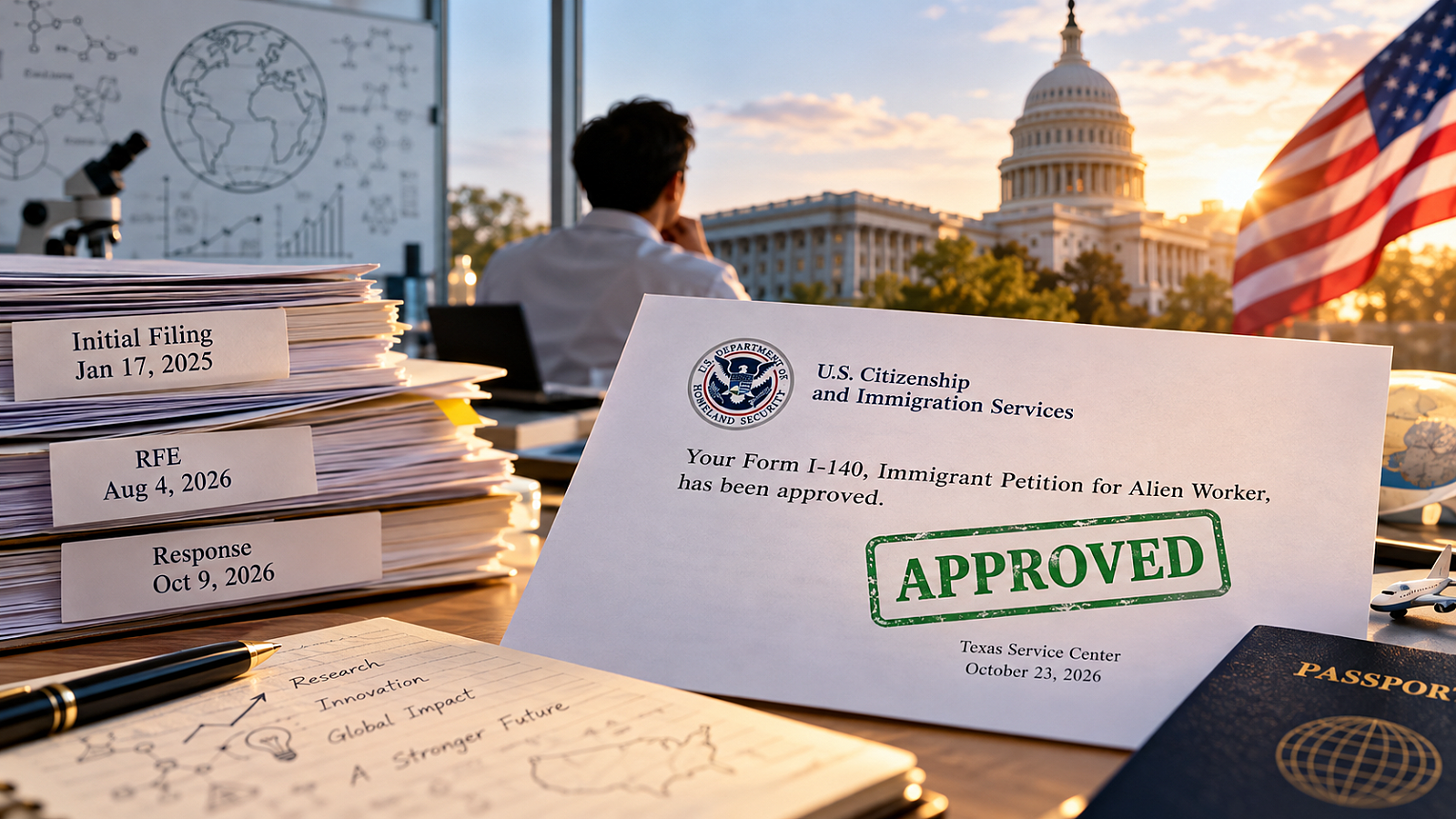
NIW 심사 지침 변경 이후, 승인을 받기까지의 과정
2026년 10월 23일, 미국 이민국(USCIS) 텍사스 서비스센터(Texas Service Center)로부터 고객의 NIW 이민청원서가 승인되었다는 이메일을 받았습니다. 최초 접수일로부터 21개월이 넘는 시간이 흐른 뒤에야 얻은 결과였습니다. 그 과정에서는 이민국 통지서의 미수령, 심사 지침 변경, 광범위한 추가서류요청(RFE) 등 예상치 못한 여러 문제가 발생했습니다.
해당 고객은 과학 분야에서 뛰어난 연구 성과를 쌓아온 전문가였습니다. 고객은 당사를 통해 EB-2 NIW를 진행하는 동시에, 미국의 대형 이민법률사무소를 통해 별도의 EB-1A 특기자 이민도 신청한 상태였습니다. 그러나 EB-1A 청원은 최종적으로 거절되었고, 이에 따라 NIW 승인 여부는 고객과 가족의 향후 이민 계획에서 더욱 중요한 의미를 갖게 되었습니다.
■ 심사 지침 변경과 맞물린 NIW 청원
미국 이민국은 2025년 1월 17일, 고객의 NIW 이민청원서를 일반심사(Regular Processing)로 접수했습니다. 고객은 우수한 전문 자격과 연구 실적을 갖추고 있었으며, 최초 청원서에도 이를 입증할 상당한 증빙자료가 포함되어 있었습니다. 특히 추천서 중 한 부는 노벨 물리학상 수상자가 작성한 것으로, 고객의 과학적 기여를 이해하고 평가할 수 있는 전문가들의 수준을 보여주는 자료였습니다.
그런데 청원서 접수 시점이 중요한 변수로 작용했습니다. 이민국은 접수일로부터 불과 이틀 전인 2025년 1월 15일, NIW 자격요건 심사에 관한 새로운 정책 지침을 발표했습니다.
당사의 청원서는 해당 정책이 발표되기 전에 이미 작성과 발송을 마친 상태였습니다. 따라서 새로운 지침을 반영해 청원서의 논거를 수정할 기회가 없었습니다. 이러한 시기적 차이가 어떤 영향을 미쳤는지는 1년이 훨씬 지난 뒤에야 드러나게 됩니다.
그러나 가장 먼저 발생한 문제는 심사 기준보다 훨씬 기본적인 행정 문제였습니다. 바로 이민국 접수통지서(Receipt Notice)가 도착하지 않은 것이었습니다.
이민국은 청원서를 정상적으로 접수하고 우선일자(Priority Date)까지 부여했지만, 고객과 당사 모두 우편으로 발송되는 공식 접수통지서를 받지 못했습니다. 다행히 최초 접수 당시 전자통지 신청서인 Form G-1145를 함께 제출했기 때문에, 전자 알림을 통해 접수번호를 확인할 수 있었습니다.
이후 수개월 동안 당사는 이민국에 여러 차례 연락하여 접수통지서 사본을 요청했습니다. 그러나 이민국 기록상으로는 이미 통지서가 발송된 상태였고, 실제로는 고객과 당사 어느 쪽에도 도착하지 않았습니다.
이 문제는 고객이 나중에 급행심사(Premium Processing)로 전환하기로 결정하면서 더욱 복잡해졌습니다.
NIW는 처음부터 급행심사로 접수할 수도 있지만, 일반심사로 진행하다가 추후 급행심사로 전환하는 것도 가능합니다. 이러한 방식은 심사 대기 기간에 이민국의 심사 경향이나 신청자의 상황이 달라졌을 때 유연하게 대응할 수 있다는 장점이 있습니다.
2025년 1월 정책 지침 변경 직후 몇 개월은 NIW 신청자들에게 특히 어려운 시기였으며, 승인 사례도 상대적으로 적었습니다. 결과적으로 고객이 급행심사 전환을 늦춘 것이 오히려 유리하게 작용했을 가능성이 있습니다.
일반적으로 진행 중인 이민청원을 급행심사로 전환할 때는 기존 접수통지서 사본을 함께 제출합니다. 그러나 당사는 해당 서류를 받은 적이 없었기 때문에, 이민국에 접수통지서를 요청하며 주고받았던 이메일 기록을 정리하여 급행심사 신청서와 함께 제출했습니다.
텍사스 서비스센터는 이를 받아들였고, 고객의 NIW 청원은 45영업일의 급행심사 처리 기한이 적용되는 절차로 전환되었습니다.
■ 두 건의 이민청원, 그리고 연이은 심사 난관
NIW 급행심사 전환이 진행될 무렵, 고객이 다른 미국 이민법률사무소를 통해 신청했던 EB-1A 청원에도 추가서류요청(RFE)이 발행되었습니다. 해당 EB-1A 청원은 이후 최종적으로 거절되었습니다.
다만 EB-1A 수속 과정에서 준비한 자료들은 NIW 심사에서 유용하게 활용할 수 있었습니다. 고객은 EB-1A 추가서류요청에 대응하면서 자신의 전문적 성과를 입증하는 상당한 양의 자료를 이미 확보한 상태였고, 그중 다수는 NIW 청원을 보강하는 데에도 활용할 수 있었기 때문입니다.
2026년 8월 4일, 이민국은 NIW 청원에도 추가서류요청을 발행했습니다. 이번 RFE에서는 NIW 심사 기준인 Matter of Dhanasar의 세 가지 요건 모두에 대해 문제를 제기했습니다.
이민국은 추가서류요청서에서 2025년 1월 15일 발표된 정책 지침을 구체적으로 언급했습니다. 고객의 미국 내 추진 계획(Proposed Endeavor)이 실질적 가치(Substantial Merit)와 국가적 중요성(National Importance)을 갖추고 있는지, 고객이 해당 계획을 추진할 충분한 역량을 갖추고 있는지(Well Positioned), 그리고 취업 제안 및 노동허가 요건을 면제하는 것이 미국의 국익에 부합하는지에 대해 추가적인 입증을 요구했습니다.
최초 청원서는 2025년 1월 15일 이전의 정책 지침을 기준으로 준비되었습니다. 그러나 이제는 개정된 이민국 정책 매뉴얼(USCIS Policy Manual)과 심사관이 제기한 구체적인 의문을 토대로 기존의 논거를 다시 검토해야 하는 상황이 되었습니다.
RFE 발행 시점에는 한 가지 다행스러운 점도 있었습니다. 2026년 8월 5일, 이민국은 RFE 답변 기한에 관한 새로운 정책 지침을 발표하면서 심사관들에게 보다 짧은 답변 기간을 부여하도록 권고했습니다.
다행히 고객의 RFE는 해당 정책 발표 하루 전인 8월 4일 발행되었고, 답변서 제출 기한은 2026년 10월 30일로 지정되어 있었습니다. 덕분에 기존의 비교적 긴 답변 준비 기간을 확보할 수 있었고, 광범위한 자료 검토와 답변서 작성이 가능했습니다.
■ 기존 자료를 재검토하고 새로운 논거를 구축한 RFE 대응
이번 RFE에 대응하기 위해서는 고객의 자격과 기존 증빙자료 전반을 다시 검토해야 했습니다. 당사는 먼저 심사관이 제기한 문제를 분석하고, 각각의 쟁점에 어떻게 대응할 것인지 답변서 작성 방향을 수립했습니다. 이후 고객에게 이민국이 어떤 부분에 대한 추가 입증을 요구하는 것으로 보이는지 설명하고, 각 쟁점에 대응하기 위한 자료 준비 계획을 마련했습니다.
그 후 약 두 달 동안 고객과 긴밀하게 협력하며 답변서를 준비했습니다. 특히 고객이 자신의 연구와 발명 기술이 갖는 의미를 직접 설명해 준 것이 큰 도움이 되었습니다.
이번 케이스에서 주목할 만한 부분은 청원서가 심사 대기 상태에 있는 동안 기존 성과의 입증력이 더욱 강화되었다는 점입니다. 최초 접수 당시 제출했던 일부 연구 및 기술 성과가 시간이 지나면서 새로운 증빙자료로 뒷받침되었고, 이를 통해 해당 성과의 중요성과 실제 활용 가치를 더욱 구체적으로 설명할 수 있게 되었습니다.
당사는 고객의 논문과 발명 기술이 어떤 내용을 담고 있는지, 다른 연구자나 전문가들이 해당 성과를 어떻게 활용해 왔는지를 면밀하게 검토했습니다. 특히 이러한 성과가 고객의 미국 내 추진 계획을 실현할 수 있는 역량과 어떻게 연결되는지, 나아가 미국에 어떤 기여를 할 수 있는지를 설명하는 데 중점을 두었습니다.
논문, 특허, 인용 횟수는 NIW 자격을 입증하는 데 유용한 자료가 될 수 있습니다. 그러나 단순히 이러한 실적이 존재한다는 사실만으로 충분한 것은 아닙니다. 각각의 자료가 무엇을 입증하는지, 그리고 신청자의 전문성과 향후 미국 내 활동을 어떻게 뒷받침하는지가 중요합니다.
이번 케이스에서도 핵심은 고객의 전문적 역량과 향후 미국에서 수행할 활동의 중요성을 일관성 있게 설명하는 것이었습니다.
최종적으로 완성된 RFE 답변서는 새로운 이민청원서 한 건에 가까울 만큼 방대하고 체계적인 자료로 구성되었습니다. 상당한 양의 추가 증빙자료를 포함했으며, 고객의 연구 및 기술 성과가 해당 전문 분야와 미국 국민의 일상생활에 어떤 가치를 제공할 수 있는지 상세하게 설명했습니다.
2026년 10월 9일, 답변서가 이민국에 도착했습니다. 그리고 정확히 14일이 지난 10월 23일, 텍사스 서비스센터로부터 NIW 청원이 승인되었다는 확인 이메일을 받았습니다.
■ NIW 승인, 그리고 마지막까지 이어진 예상 밖의 문제
이번 승인은 고객에게 특히 의미 있는 결과였습니다. 이미 별도로 진행했던 EB-1A 청원에서 거절을 경험한 데다, NIW에서도 광범위한 추가서류요청에 대응하기 위해 수개월 동안 상당한 시간과 노력을 기울여야 했기 때문입니다.
고객은 이민 계획의 불확실성이 이어지는 상황에서도 자신의 전문적 경력을 꾸준히 발전시켜 왔습니다. 특히 RFE 답변서를 준비하는 과정에서 자신의 연구와 기술적 성과가 갖는 의미를 상세하게 설명하며 적극적으로 협력했습니다. 이러한 고객의 참여는 답변서의 완성도를 높이는 데 중요한 역할을 했습니다.
그런데 승인을 확인하는 이메일에서도 또 하나의 예상치 못한 문제가 발견되었습니다.
고객은 최초 청원서 접수 이후 RFE가 발행되기 전까지 거주지를 이전했습니다. 당사는 RFE 답변서를 준비하면서 이민국의 주소 변경 안내에 따라, RFE 통지서에 새로운 우편물 수령 주소를 직접 수기로 기재했습니다. 국가명 역시 "Republic of Korea"라고 명확하게 작성했습니다.
그러나 이민국이 발송한 승인 안내 이메일에는 고객의 주소가 "North Korea"로 표기되어 있었습니다.
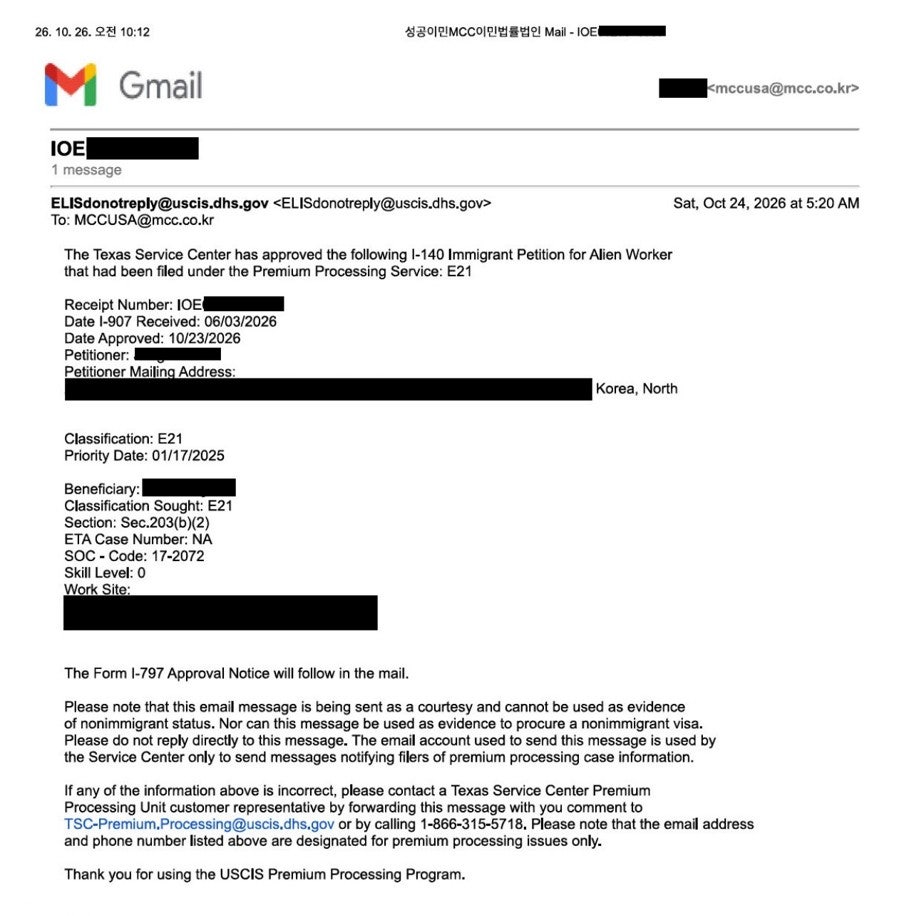
이 글을 작성하는 시점까지 공식 승인통지서 원본은 아직 도착하지 않았습니다. 만약 승인통지서에도 동일한 오류가 기재되어 있다면, 이를 정정하는 것이 이번 케이스의 다음 과제가 될 것입니다.
최초 접수 이후 21개월이 넘는 시간이 지나 고객의 NIW 이민청원은 최종 승인되었습니다. 이번 사례는 NIW 수속이 최초 청원서를 제출하는 것으로 끝나는 절차가 아니라는 점을 보여줍니다. 고객의 우수한 전문 자격은 청원의 중요한 기반이 되었고, 이후 확보한 추가 증빙자료와 수개월에 걸친 긴밀한 협력을 통해 심사관의 우려 사항에 더욱 충실하게 대응할 수 있었습니다.
다른 취업이민 카테고리에서 청원이 거절되고, 수속 과정에서 예상치 못한 행정적 문제까지 겪어야 했던 고객에게 이번 승인은 길었던 이민 여정의 한 단계를 성공적으로 마무리하는 결과였습니다.
이제 고객은 승인된 NIW 이민청원을 바탕으로 미국 이민을 향한 다음 단계를 준비할 수 있게 되었습니다.
-----------------------------
What it took to Secure NIW Approval After a Major Policy Change
On October 23, 2026, the Texas Service Center emailed our office confirming the approval of a client's National Interest Waiver petition. The decision came more than 21 months after the initial filing, following an unusually complicated process involving missing USCIS documents, changes in adjudication guidance, and an extensive Request for Evidence.
The client was an accomplished professional with a strong record of scientific contributions. He had also pursued a separate EB-1A petition through a large U.S. immigration law firm, while our office handled his NIW case. His EB-1A petition was ultimately denied, making the outcome of his NIW petition especially important to his family’s future.
■ A Strong Petition Caught Between Changing Policies
USCIS received the client's NIW petition on January 17, 2025, under regular processing. His qualifications were impressive, and the original petition included substantial supporting evidence. One of the recommendation letters was written by a Nobel Prize-winning physicist, reflecting the caliber of professionals familiar with his scientific contributions.
The timing of the filing turned out to be significant. On January 15, just two days before USCIS received the petition, the agency published updated guidance concerning the evaluation of NIW eligibility.
Our petition had already been fully prepared and sent to USCIS before the policy update was announced, leaving no opportunity to revise its arguments in response to the new guidance. The consequences of that timing would become apparent more than a year later.
The first difficulty, however, involved something far more ordinary: a missing receipt notice.
Although USCIS had accepted the petition and assigned a priority date, neither the client nor our office received the physical receipt notice. Fortunately, Form G-1145 had been submitted with the original filing, allowing us to obtain the receipt number through electronic notification.
Over the following months, our office repeatedly contacted USCIS requesting a copy. Each time, its records indicated that the notice had already been sent, yet neither the client nor our office ever received it.
The missing notice became particularly troublesome when the client later decided to upgrade his petition to premium processing.
Premium processing can be requested after an NIW petition has already been filed, allowing applicants to begin with regular processing and seek expedited adjudication later. This flexibility can be useful when USCIS adjudication practices or an applicant's circumstances change during the waiting period.
The months immediately following the January 2025 policy update had been especially difficult for NIW applicants, with relatively few approvals. In retrospect, the later upgrade seems to have been more advantageous for the client.
Ordinarily, upgrading a pending petition to premium processing involves submitting a copy of the original receipt notice. Since we had never received one, we assembled the correspondence emails documenting its previous attempts to obtain the missing document and submitted it with the upgrade request.
The Texas Service Center accepted the submission, and the petition entered premium processing under the 45-business-day timeframe.
■ Two Petitions Facing Difficult Decisions
Around the time of the NIW premium processing upgrade, the client's separately filed EB-1A petition received an RFE. That petition was subsequently denied.
The EB-1A proceedings nevertheless provided something useful for the NIW case. In preparing for the EB-1A RFE, the client had already gathered considerable additional evidence of his professional accomplishments, much of which could also be used to support his NIW petition.
On August 4, 2026, USCIS issued an RFE on the NIW petition, challenging all three prongs of the Dhanasar framework.
The RFE made specific references to the January 15, 2025 policy update. USCIS questioned whether the proposed endeavor had substantial merit and national importance, whether the client was well positioned to advance it, and whether granting the waiver would benefit the United States on balance.
The original petition had been prepared under the guidance available before January 15, 2025. Now, the arguments needed to be reconsidered in light of the updated Policy Manual and the adjudicator's specific concerns.
The timing of the RFE brought one advantage. On August 5, 2026, USCIS issued another policy update specifically addressing RFE response deadlines, encouraging officers to assign shorter RFE response periods. Fortunately, our client's RFE had been issued the previous day, with a response deadline of October 30, 2026. This provided the customary longer period to prepare what would become an extensive submission.
■ Building a New Case from an Existing Record
The RFE required a comprehensive reassessment of the client's qualifications and supporting evidence. We began by examining the adjudicator's concerns and developing a roadmap for the response. The client was then informed of what USCIS appeared to be asking for, and a plan was established for addressing each issue.
Over the following couple of months, we worked closely with the client to prepare the response. His technical knowledge was especially valuable in explaining the significance of his research and inventions.
One of the strongest aspects of the case was how the evidence had developed during the time the petition remained pending. Some of the accomplishments documented in the initial filing had matured into stronger evidence, providing additional insight into their significance and practical impact.
The response examined the substance of his publications and inventions, including how others had relied upon his work. Particular attention was given to explaining how those achievements demonstrated his ability to advance the proposed endeavor and contribute to the United States.
Publications, patents, and citations can provide valuable support for NIW eligibility, but their significance depends on what they establish. In this case, the evidence needed to tell a coherent story about the client's professional capabilities and the importance of his future work in the U.S.A.
The final response was robust and comprehensive, approaching the scope of an entirely new petition. It incorporated substantial additional documentation thorough explanation of why the client’s accomplishments are valuable to his field and to everyday Americans.
By October 9, 2026, the response had been delivered to USCIS. On October 23, just 14 days after that date, the Texas Service Center confirmed that the NIW petition had been approved.
■ An Approval, and One More Unexpected Complication
The approval was particularly meaningful for a client who had already experienced an EB-1A denial and devoted several months to responding to another extensive RFE.
Throughout the process, he had continued building his professional record while dealing with considerable uncertainty surrounding his immigration plans. His involvement in preparing the NIW response was essential, particularly when it came to explaining the technical significance of his work.
Yet even the approval email contained another unwelcomed surprise.
Between the original filing and the RFE, the client had moved. When preparing the RFE response, our office followed USCIS's instructions for updating his mailing address by handwriting the new information directly on the RFE notice. The country was specifically identified as "Republic of Korea."
The approval email, however, listed the client's address as "North Korea."
At the time of writing, the physical approval notice has not yet arrived. If the same error appears on that document, correcting it will become the next step in this case.
After more than 21 months, the immigration petition was finally approved. This case illustrates the work that can go into an NIW petition long after the original filing. The client's qualifications provided a strong foundation, while the additional evidence and months of collaboration allowed the RFE response to address USCIS's concerns in greater depth.
For someone who had already experienced an unsuccessful petition in another employment-based category and administrative mishaps, the approval brought a welcome conclusion to a lengthy chapter of his immigration journey. The next chapter can now begin with an approved NIW petition.

미국 변호사와 이민 전문가가 꼼꼼하게 검토 후 최적의 솔루션을 안내해 드립니다.
