미국 변호사와 이민 전문가들이 전하는 심층 분석 리포트입니다.
이 케이스에서 중요했던 것은 ‘많이 제출하는 것’이 아니라 ‘정확하게 대응하는 것’이었습니다
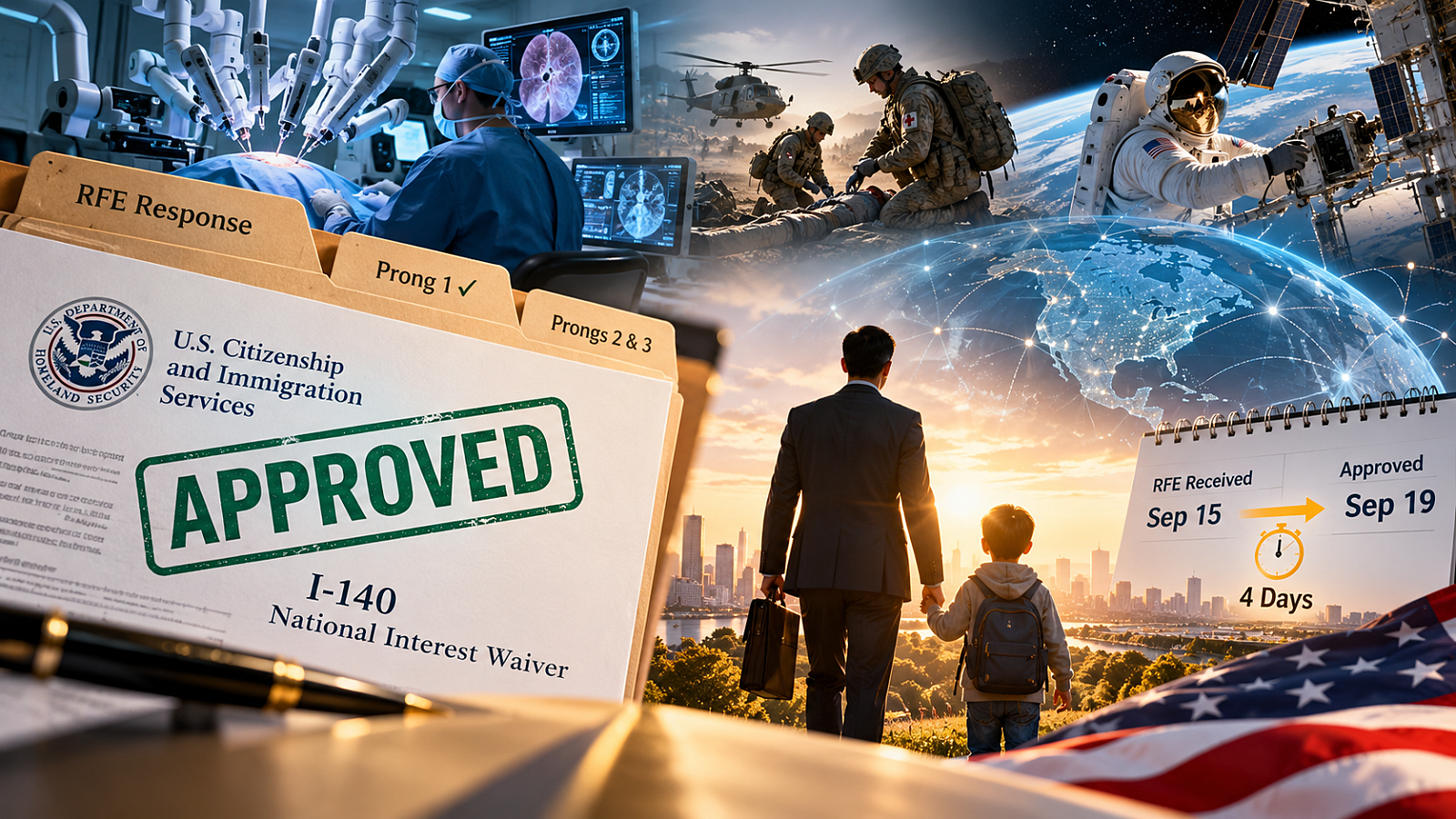
최근 저희가 진행한 NIW 케이스가 USCIS에서 RFE 답변 접수 사실을 확인한 뒤 불과 4일 만에 최종 승인되었습니다.
신청자는 소프트웨어 엔지니어로, 석사 학위와 15년 이상의 경력을 보유하고 있었으며 실제 상용 제품에 적용된 특허 실적도 갖추고 있었습니다. 학술 논문은 많지 않았지만, 오랜 기간 축적된 실무 경험과 기술적 성과가 강점인 케이스였습니다.
이번 케이스에서 특히 주목할 점은 USCIS가 RFE를 통해 Dhanasar 2단계와 3단계만 문제 삼았고, 1단계는 이미 충족한 것으로 명확하게 인정했다는 점입니다.
즉, Proposed Endeavor의 Substantial Merit와 National Importance는 최초 접수 단계에서 이미 인정된 상태였습니다.
남은 쟁점은 신청자가 실제로 그 Proposed Endeavor를 추진할 수 있을 만큼 충분히 준비되어 있는지, 그리고 고용제안 및 노동허가 절차를 면제하는 것이 미국에 이익이 되는지였습니다.
■ 병원 안의 수술만을 위한 기술은 아니었습니다
이번 Proposed Endeavor의 중요성을 설명할 때 단순히 “수술로봇 산업이 중요하다”는 수준으로 접근하지 않았습니다.
신청자가 추진하고자 하는 기술은 일반적인 병원 수술실뿐 아니라, 전문 의료진이 환자와 같은 장소에 있기 어려운 환경에서도 활용될 수 있는 가능성을 가지고 있었습니다.
예를 들어 전장 의료, 원격지 의료, 우주 환경처럼 숙련된 외과의가 현장에 직접 접근하기 어려운 상황에서는 원격수술과 수술로봇 기술의 중요성이 더욱 커질 수 있습니다.
결국 핵심은 특정 병원이나 특정 제품의 성능을 높이는 데 그치는 것이 아니라, 거리와 환경의 제약으로 인해 전문 의료서비스 제공이 어려운 상황에서도 수술 역량을 확장할 수 있는 기술이라는 점이었습니다.
이러한 점이 Proposed Endeavor의 잠재적 영향 범위를 보다 넓게 설명하는 데 중요한 역할을 했습니다.
■ 승인만큼 중요했던 또 하나의 전략, CSPA
이번 케이스에는 또 하나의 중요한 변수가 있었습니다.
신청자의 자녀가 동반 영주권을 받을 수 있을지 여부가 시간적으로 매우 민감한 상황이었습니다.
신청자 역시 자녀가 최종적으로 함께 영주권을 받지 못할 가능성이 높다는 점을 이미 인지하고 있었습니다. 하지만 당시 Visa Bulletin이 Current 상태였고, 저희는 과거 유사한 상황을 경험한 적이 있었기 때문에 단순히 “이제는 어렵다”고 판단하지 않았습니다.
실제 나이, 접수 시점, I-140 계류기간 등을 기준으로 다시 계산해 보았고, 빠르게 움직인다면 아직 가능성을 살릴 수 있는 여지가 있다고 판단했습니다.
그래서 이번 케이스에서는 가능한 한 이른 시점에 Priority Date를 확보하는 것이 매우 중요했습니다.
다만 단순히 빨리 접수하는 것이 목표는 아니었습니다. NIW 청원서의 완성도를 유지하면서도, 불필요한 지연을 줄이고 최대한 빠르게 접수할 수 있도록 준비해야 했습니다.
결과적으로 2026년 6월에 I-140을 접수했고, 최종 승인 당시에도 Visa Bulletin은 Current 상태였습니다.
승인 이후 NVC Welcome Letter도 매우 빠르게 발급되었습니다. 실무상 저희가 경험한 사례 중에서도 가장 빠른 편이었고, 최근에는 Welcome Letter의 문서 형식 자체도 과거와 달라진 점을 확인할 수 있었습니다.
■ RFE는 Prong 2와 Prong 3에 집중되었습니다
RFE는 2026년 8월 13일 발행되었습니다.
이미 Prong 1이 인정된 상태였기 때문에 이번 답변에서 National Importance를 처음부터 다시 입증할 필요는 없었습니다.
일반적인 NIW 청원서나 RFE 답변에서는 미국 정부 보고서, 정책자료, 법령, 산업 관련 자료 등 상당한 분량의 배경자료가 포함되는 경우가 많습니다.
하지만 이번 케이스에서는 그러한 자료를 반복할 이유가 없었습니다.
대신 USCIS가 실제로 문제 삼은 부분과 직접 연결되는 자료만 선별했습니다.
그 결과 이번 RFE 답변은 일반적인 NIW RFE 답변보다 오히려 분량이 짧았습니다.
중요한 점은 페이지 수가 아니었습니다.
무엇을 더 넣을 것인가보다, 무엇을 남기고 무엇을 제외할 것인가가 더 중요했습니다.
■ 접수 이후 만들어진 자료는 사용할 수 없는가?
이번 RFE에서 가장 흥미로운 법적 쟁점 중 하나는 Priority Date 이후에 만들어진 증거를 어디까지 사용할 수 있는가였습니다.
RFE의 표현만 보면, 접수 이후 생성된 자료는 USCIS가 받아들이지 않을 수 있다는 인상을 줄 수 있었습니다.
하지만 여기에는 중요한 구분이 필요합니다.
NIW 신청자는 I-140 접수일 기준으로 자격을 갖추고 있어야 합니다.
그러나 그 자격을 입증하기 위해 제출하는 모든 문서가 반드시 접수일 이전에 작성되어 있어야 하는 것은 아닙니다.
이번 답변에서는 이 부분을 명확히 하기 위해 AAO 결정을 활용했습니다. 해당 결정에서도 신청자가 접수 당시 이미 자격요건을 갖추고 있었다면, 이후 작성된 자료가 그 기존 사실과 계획을 설명하거나 보완하는 용도로 제출될 수 있다는 점이 문제되었습니다.
즉, 중요한 것은 새로운 자격을 접수 이후에 만들어내는 것이 아니라, 접수 당시 이미 존재했던 자격과 활동을 나중에 작성된 자료로 보다 명확하게 입증하는 것입니다.
이번 케이스에서도 Priority Date 이후에 작성되거나 공식화된 자료들이 일부 있었습니다.
예를 들어 여러 특허출원 자료가 있었지만, 단순히 출원일만을 근거로 삼지 않았습니다. 관련 증거를 통해 실제 기술개발과 발명 활동 자체는 출원보다 훨씬 이전에 이루어졌다는 점을 설명했습니다.
이렇게 해야 새로운 자료가 기존 청원서를 대체하는 것이 아니라, 기존에 이미 존재했던 Proposed Endeavor와 신청자의 역량을 보완하고 구체화하는 증거가 됩니다.
■ 새로운 자료보다 더 중요했던 것은 ‘기존 기록으로 다시 돌아가는 것’이었습니다
이번 RFE 답변에서는 새롭게 제출하는 자료와 최초 접수 당시 이미 제출했던 자료를 명확하게 구분했습니다.
답변서 곳곳에서 USCIS가 최초 청원서의 어느 부분을 다시 봐야 하는지 의도적으로 안내했습니다.
RFE가 왔다고 해서 케이스를 처음부터 다시 만드는 방식으로 접근하지 않았습니다.
오히려 기존 기록에서 이미 입증된 부분은 다시 상기시키고, 부족했던 부분만 새로운 자료로 보완하는 구조로 답변했습니다.
추가로 제출된 의견서들은 신청자가 실제 프로젝트에서 어떤 역할을 했는지, 단순한 참여자가 아니라 어떤 기술적 책임과 기여를 했는지를 보다 구체적으로 설명하는 데 활용되었습니다.
또한 별도의 독립 전문가 평가도 추가해, 신청자의 경력과 Proposed Endeavor에 대한 외부 시각을 보완했습니다.
관련 기술이 전문 학회와 행사에서 소개되고 업계 관계자들이 이를 접할 기회가 있었다는 자료도 함께 제출했습니다.
하지만 이러한 자료를 많이 넣는 것 자체가 목적은 아니었습니다.
각 자료가 Prong 2와 Prong 3의 어느 쟁점을 보완하는지 명확하게 연결하는 것이 더 중요했습니다.
■ 짧은 RFE 기한, 그리고 4일 만의 승인
이번 RFE는 답변 기한이 비교적 짧았습니다.
따라서 법률적 대응뿐 아니라 서류 준비와 발송 일정까지 함께 관리해야 했습니다.
저희는 촉박한 기한을 고려해 신뢰할 수 있는 배송 방법을 확보했고, 9월 7일 RFE 답변서를 발송했습니다.
USCIS 시스템에는 9월 15일 RFE Response Received로 상태가 변경되었습니다.
그리고 불과 4일 뒤인 9월 19일, 최종적으로 Case Approved가 확인되었습니다.
■ 이번 사례에서 가장 중요한 점
이번 케이스는 단순히 “RFE가 나왔지만 승인됐다”는 사례로 보기에는 아쉬운 점이 많습니다.
이미 Prong 1은 최초 접수 단계에서 인정된 상태였고, 이후 답변은 Prong 2와 Prong 3에만 집중했습니다.
접수 이후에 생성된 자료도 무조건 배제하지 않고, 그것이 접수 당시 이미 존재했던 자격과 활동을 설명하는 증거라는 점을 법적으로 구분했습니다.
새로운 자료와 기존 자료를 명확하게 구분했고, 답변서의 분량보다 논리의 집중도를 우선했습니다.
그리고 동시에 자녀의 CSPA 가능성까지 고려해 초기 접수 시점부터 속도와 완성도를 함께 관리해야 했습니다.
결국 이번 케이스에서 중요한 것은 단순히 많은 자료를 제출한 것이 아니었습니다.
언제 접수해야 하는지, 무엇을 제출해야 하는지, 어떤 자료는 빼야 하는지, 그리고 기존 기록과 새로운 자료를 어떻게 연결해야 하는지를 판단하는 전략이 중요했습니다.
----------------------------------------
NIW Approved 4 Days After RFE Response:
What Made This Case Different?
A recent NIW case we handled was approved just four calendar days after USCIS recorded the RFE response as received.
The petitioner was a software engineer with a master’s degree, more than 15 years of experience, several patents tied to commercially implemented products, and a small number of older academic publications. The case was filed with Premium Processing, and USCIS later issued an RFE challenging Dhanasar Prongs 2 and 3.
What made the case particularly interesting was that USCIS had already expressly acknowledged that Prong 1 was satisfied.
In other words, the substantial merit and national importance of the proposed endeavor had already been accepted. The remaining questions were whether the petitioner was well positioned to advance that endeavor and whether, on balance, waiving the job offer and labor certification requirements would benefit the United States.
■ The Proposed Endeavor Extended Beyond a Conventional Hospital Setting
One important feature of the case was the potential reach of the petitioner’s proposed endeavor.
The technology was not relevant only to ordinary surgical environments. Its potential applications also extended to situations where highly specialized medical personnel may not be physically present with the patient, including battlefield medicine and space environments.
That broader context helped demonstrate why the proposed endeavor could have significance beyond one employer, one hospital, or one specific product.
■ A Time-Sensitive CSPA Strategy
There was also an important family consideration.
The petitioner had a child whose eligibility to immigrate as a derivative beneficiary was extremely time-sensitive. The petitioner was already aware that there was a high likelihood the child might no longer be eligible by the time the case was completed.
However, because the Visa Bulletin was current at the time, we did not assume that the opportunity had already been lost.
After reviewing the timing and making the CSPA calculation, we determined that there was still a meaningful possibility to preserve the child’s eligibility if the case moved quickly enough.
That made the filing timeline especially important.
The goal was not simply to file as fast as possible. It was to secure the earliest practical Priority Date while still preparing a complete and persuasive NIW petition.
The petition was filed in June 2026, and the case was ultimately approved while the Visa Bulletin remained current.
The NVC Welcome Letter was then issued unusually quickly after approval — faster than any case of this type we had previously seen. We also noticed that the format of the Welcome Letter itself had changed from the version commonly seen in earlier cases.
■ The RFE Focused on Prongs 2 and 3
The RFE was issued on August 13, 2026, during Premium Processing.
Because Prong 1 had already been accepted, the response did not need to repeat the large volume of government reports, policy materials, industry initiatives, and other background evidence normally used to establish national importance.
Instead, the response was intentionally selective.
The goal was to include everything that directly mattered to the issues raised by USCIS, while excluding material that would only make the filing longer without making the argument stronger.
As a result, the response package was actually shorter than many NIW RFE responses we prepare.
That was deliberate.
More pages do not necessarily mean a stronger response.
■ New Evidence, But Not a New Case
One of the more legally interesting issues involved evidence that came into existence after the Priority Date.
The RFE language appeared to raise concern about whether USCIS would consider documents created after the petition had been filed.
This required an important distinction.
An NIW petitioner must be eligible as of the filing date. But that does not mean every document used to prove that eligibility must also have existed on the filing date.
We relied on an AAO decision that addressed this issue directly. In that case, the AAO explained that USCIS may consider later-created documents when they further document, explain, or corroborate circumstances and plans that already existed when the petition was filed.
That distinction became important in this case because several pieces of evidence were created or finalized after the Priority Date.
The response therefore carefully explained that these materials were not being used to create a new basis for eligibility. Instead, they documented work, planning, technical development, and professional momentum that had already begun before filing.
Several later-filed patent applications were handled in this manner as well. We did not rely on the filing dates alone. The supporting evidence clarified that the underlying inventive work had already taken place before the applications themselves were formally filed.
■ Returning USCIS to the Original Record
Another important part of the response was organization.
We clearly distinguished between evidence that had already been submitted with the original petition and evidence being added with the RFE response.
At strategic points, the response specifically directed USCIS back to the original filing rather than treating the RFE as if the entire case had to be rebuilt from the beginning.
The new supporting letters also helped clarify the petitioner’s actual role in important projects, while a second independent expert evaluation provided an additional outside assessment of the petitioner’s qualifications and proposed work.
We also submitted evidence showing that the relevant technology had been presented at professional conferences and introduced to interested industry participants.
The purpose of these materials was not to overwhelm the record.
It was to make the existing record clearer.
■ A Tight Deadline Required Careful Execution
The RFE response deadline was relatively short, so the case required close coordination from both a legal and logistical standpoint.
Because of the urgency, we secured a reliable delivery method and sent the response on September 7.
USCIS updated the case status to show that the RFE response had been received on September 15.
Four calendar days later, on September 19, the case was approved.
■ The Main Lesson
This case was a good reminder that a strong NIW response is not necessarily the longest response.
The more important question is whether the evidence directly addresses the issues USCIS has raised.
In this case, Prong 1 had already been established. The response therefore stayed focused on Prongs 2 and 3, carefully distinguished newly submitted evidence from the original record, addressed the legal issue surrounding post-filing documentation, and kept the argument concise.
At the same time, the case required close attention to the petitioner’s family situation because the CSPA timing was extremely narrow.
The result was not simply a fast approval.
It was a case in which filing strategy, evidence selection, legal analysis, and timing all had to work together.

미국 변호사와 이민 전문가가 꼼꼼하게 검토 후 최적의 솔루션을 안내해 드립니다.
