 ■ EB-3 Unskilled, the Most Realistic Path to a U.S. Green Card
The EB-3 Unskilled (Other Workers) category is considered the most realistic alternative for many overseas workers dreaming of obtaining a U.S. green card, in that it does not require a high level of education or professional experience. Thanks to its structure, which allows applicants to apply for a green card with sponsorship from a U.S. employer, applicants from various countries such as Thailand, Mexico, Central Asia, and Korea flock to this system.
However, the process is not simple. It requires going through multiple stages, including labor certification (PERM), an immigrant petition (I-140), National Visa Center (NVC) processing, and an interview, and the annual global quota limit of 10,000 inevitably creates an applicant backlog. A problem that many applicants overlook in this process is precisely the gap in legal status.
■ The Gap Between Approval and Residency
I-140 approval means "the petition has been accepted," but it does not immediately guarantee the right to reside or work within the U.S. In this respect, EB-3 Unskilled applicants are placed in a unique 'blind spot.'
For those waiting overseas: Even if the I-140 is approved while in Korea or one's home country, there is no way to enter the U.S. until the actual interview and visa issuance are completed. This period can range from a few months to several years or more.
For those staying within the U.S.: Many people proceed with the EB-3 process while maintaining a temporary visa, such as a student visa (F-1) or a short-term visitor visa (B-2). However, if the temporary visa expires faster than the EB-3 process progresses, there is a risk of falling into unlawful status. If unlawful presence exceeds 180 days, it can even lead to an entry ban, which can invalidate the entire process.
In other words, even though the applicant is a "future green card holder," they currently remain a "foreign national with unstable legal status."
■ The Complicated Reality for Accompanying Family Members
EB-3 allows not only the principal applicant but also a spouse and children to accompany. However, the problems families face during the waiting period are even more complex.
The Issue of a Child's Age (Application of CSPA)
- The Child Status Protection Act (CSPA) protects children so that they can maintain derivative eligibility under certain conditions even after turning 21.
- However, if the waiting period becomes long, some children may lose derivative eligibility depending on the calculation method.
- In practice, there are cases where the expectation of "being able to obtain a U.S. green card together with parents" disappears during several years of waiting.
Restrictions on the Spouse's Economic Activity
- It is difficult for a spouse to obtain an independent work visa before the EB-3 process is complete.
- As a result, the entire family comes to depend on the principal applicant's income or savings, and living instability grows during a long wait.
Pressure of Family Separation
- In some cases, the applicant goes to the U.S. for work first, while the spouse and children must wait in their home country.
- In this process, a double burden of education, housing, and living expenses arises, and psychological tension builds up in the family relationship.
■ The Pressure on Life Created by Uncertainty
The gap in legal status is not simply an administrative procedural issue; it affects the overall lives of the applicant and their family.
Economic instability: As sending costs, attorney fees, and living expenses overlap, financial pressure intensifies during the waiting period.
Emotional stress: The uncertainty of not knowing when an interview will be scheduled or whether the visa will actually be issued places a mental burden on the entire applicant's family.
Legal risk: For those waiting within the U.S., even a minor status violation can be fatal to the entire process. For example, a record of unauthorized employment or overstaying can become grounds for visa denial at the EB-3 interview.
■ Institutional Context and Structural Limitations
The U.S. government has set an annual quota of 10,000 for EB-3 Unskilled. This is a device to manage labor demand, but it simultaneously produces hundreds of thousands of applicants on the waiting list. Since a per-country cap (the 7% rule) also applies, applicants from certain countries cannot avoid an even longer wait.
From a policy perspective, EB-3 Unskilled is a means of supplementing essential labor in the U.S. labor market, but from the applicant's perspective, "the gap between approval and actual residency status" is institutionally left unaddressed. Because of this, applicants in each country or region are placed in a situation where they must separately devise "strategies to endure the waiting period" through brokers or sending systems.
■ Response Strategies Applicants Can Take
Thorough Status Management
- Those waiting within the U.S. must maintain legal residency status at all costs. If necessary, they can consider extending their status or switching to another visa (F-1, J-1, etc.) through an attorney.
Advance Review of Family Risks
- One must calculate whether a child's age falls within the CSPA protection range.
- A household financial plan must be established considering the spouse's restricted economic activity.
Checking Information and Schedules
- One should continuously check updates to the Department of State's Visa Bulletin and periodically review the likelihood of interview scheduling.
Collaboration with Experts
- One should work closely with immigration attorneys and consultants to prevent unnecessary delays due to missing documents or errors.
■ Facing the Invisible Risk
EB-3 Unskilled still offers an attractive opportunity to workers from countries around the world. However, in the process leading from approval to actual entry and obtaining a green card, applicants must endure instability and uncertainty within an institutional gap.
Therefore, applicants preparing for EB-3 should not simply think about "when will I get my green card," but should simultaneously plan "how to maintain legal status and stabilize the family's life during the waiting period."
This is precisely the risk management of the gap in legal status, which is often overlooked but is the most important aspect of the EB-3 Unskilled process.
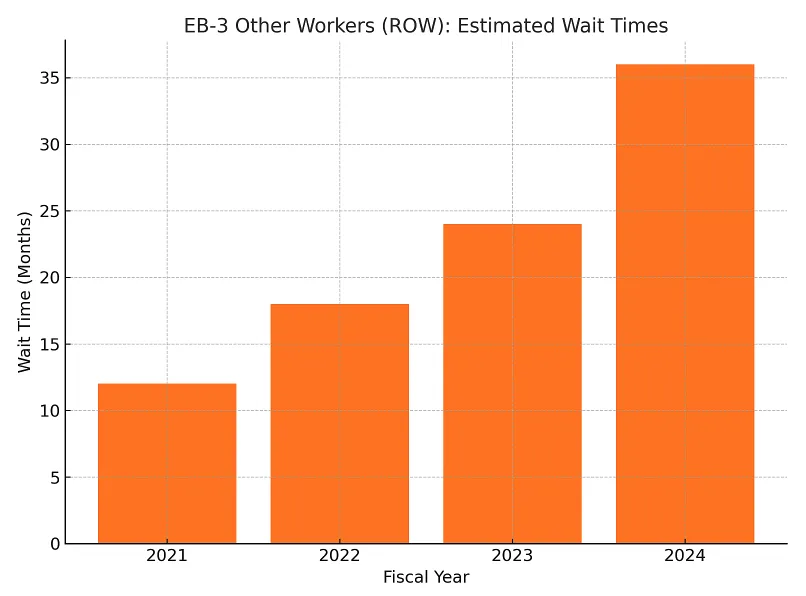
EB-3 Unskilled (ROW) Estimated Waiting Period Graph
Due to the phenomenon of priority date retrogression, the waiting period has shown a gradual increase in recent years.
*Rest of World (ROW): the group including Korea, excluding India and China