 An In-Depth Analysis of the F2A Accompanying Family System, Children's Education, and the Scope of Spousal Employment Authorization
The U.S. EB-3 (Employment-Based Third Preference) program is not simply an opportunity for one individual to work abroad.
Because this program is premised on obtaining U.S. permanent residency (an Immigrant Visa), it has an institutional foundation that allows a spouse and children to immigrate together with the principal applicant.
EB-3 immigration as a family unit is a complex decision that brings real benefits alongside greater financial and administrative preparation burdens.
This column organizes, from an expert's perspective, the legal structure and procedures of the EB-3 accompanying family system, as well as the practical factors that change when a family relocates together.
1. The Legal Structure of the EB-3 and F2A Accompanying Family System
Under Section 203(d) of the Immigration and Nationality Act (INA), the spouse and unmarried children (under 21) of a foreign national eligible for permanent residency may apply for an immigrant visa together as derivative beneficiaries of the principal beneficiary.
In this case, the visa classification granted to the spouse and children is F2A (Accompanying or Following-to-Join Family Member).
In other words, family members who enter the country within a certain period after the EB-3 principal applicant is approved receive the same permanent residency benefits.
 2. Three Key Changes When a Family Immigrates Together
① Changes in the Cost Structure of Settlement
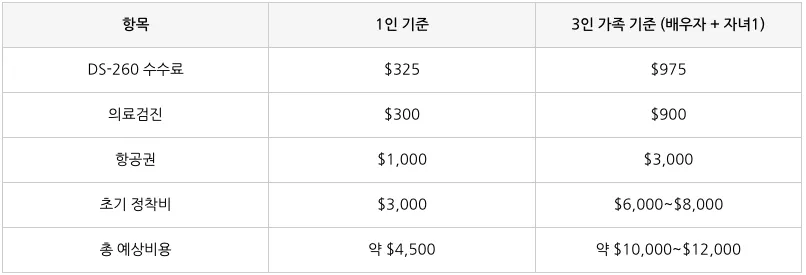
When accompanied by family, housing, living, and insurance costs increase by roughly 1.5 to 2 times compared to immigrating alone.
For example, based on the Midwest, monthly rent for one person of $900 rises to $1,600–$2,000 for a family of three, and initial settlement costs immediately after arrival—including rental deposits, furniture, a vehicle, and health insurance enrollment—require at least $6,000–$8,000 or more.
② The Spouse's Legal Right to Work (EAD)
After entering the United States, the spouse can apply for an EAD (Employment Authorization Document) to work legally.
This provision is based on 8 CFR §274a.12(a)(1) and is issued as an "Open Work Permit" with no employment restrictions.
However, approval takes 3 to 6 months, during which working is not permitted. Once the EAD is approved, the spouse can work without restriction at hospitals, educational institutions, local private companies, and more.
③ Children's Enrollment in Public School
EB-3 derivative permanent residents are guaranteed the same public education rights as U.S. citizens. In addition to free K–12 education, if residency in a state lasts 12 months or more, the family can receive the benefit of the in-state (local) tuition rate at state universities.
In addition, most states provide ESL (English as a Second Language) programs, free meal programs, and school bus services, supporting relatively quick settlement even for non-English-speaking families.
3. Procedural Summary: Family Registration Is Key at the DS-260 Stage
Once the EB-3 principal applicant's I-140 petition is approved, family information is included together at the DS-260 (Immigrant Visa Application) stage at the NVC (National Visa Center).
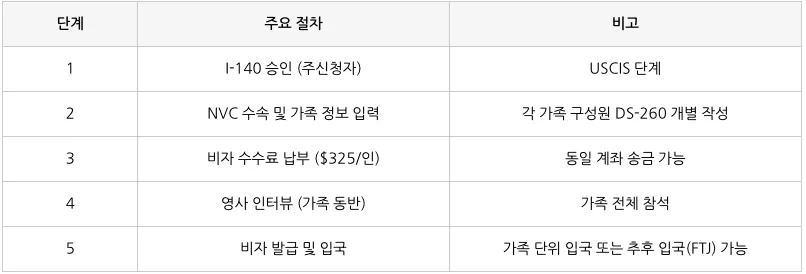 4. When Family Joins Later — The Follow-to-Join Procedure
It is also possible for the principal applicant to enter the country first and have family join later. In this case, it is called "Following-to-Join," and Form I-824 is used to link the previously approved immigrant petition with the family's visa.
- Average processing time: 6–9 months
- Visa eligibility: Existing F2A derivative status is maintained
- Validity period: Ideally within 1 year from the principal applicant's permanent residency approval date
5. Financial Requirements and Preparation Funds When Accompanied by Family
Under U.S. immigration law, since EB-3 is employment-based, there is no separate obligation to submit an Affidavit of Support (I-864) based on family size.
However, in practice, the consulate reviews the level of funds relative to family size when assessing "ability to establish residence."
 6. Family Immigration Is Not a Matter of 'Visas' but of 'Settlement'
EB-3 immigration with family is not simply a visa acquisition procedure. It is a long-term settlement process of designing a life foundation in the United States.
When a family relocates together, an employer's job offer or permanent residency approval alone is not enough. Multiple layers of social adaptation factors—education, employment, housing, health insurance, and the language environment—must be considered together.
In particular, the timing of the spouse's EAD application, the children's grade placement, the quality of school districts in the settlement city, and the distance between the residence and workplace act as key variables that determine quality of life after immigration. Therefore, if considering EB-3 as a family, one should approach it as a resettlement strategy that goes beyond the immigration process itself.
7. Approaching It as a Long-Term Settlement Structure
The core of EB-3 immigration lies not in "labor" but in "settlement." When a spouse and children are involved, immigration represents not just an individual's career move but a transition in the life of the entire family. The accompanying family system is both an institutional mechanism that opens the door to immigration and a policy signal that American society accepts skilled and unskilled workers as household-level human capital.
Family immigration requires social and economic preparation that is more complex than administrative procedures alone. Therefore, applicants preparing for EB-3 are advised to focus on the structure of long-term settlement rather than short-term costs.