 For a U.S. permanent resident (LPR, Lawful Permanent Resident), sponsoring family members is one of the most important rights. However, the scope of family sponsorship for a permanent resident is limited, and the possibilities change significantly depending on whether one has obtained citizenship. This column compares and analyzes the range of family members a permanent resident can sponsor and how this changes upon becoming a citizen.
1. The Scope of Family a Permanent Resident Can Sponsor
For a U.S. permanent resident (LPR, Lawful Permanent Resident), sponsoring family members is one of the most important rights. However, the scope of family sponsorship for a permanent resident is limited, and the possibilities change significantly depending on whether one has obtained citizenship. This column compares and analyzes the range of family members a permanent resident can sponsor and how this changes upon becoming a citizen.
1. The Scope of Family a Permanent Resident Can Sponsor
The U.S. Immigration and Nationality Act (INA) classifies family-sponsored immigration into Family Preference Categories. For permanent residents, the following categories apply.
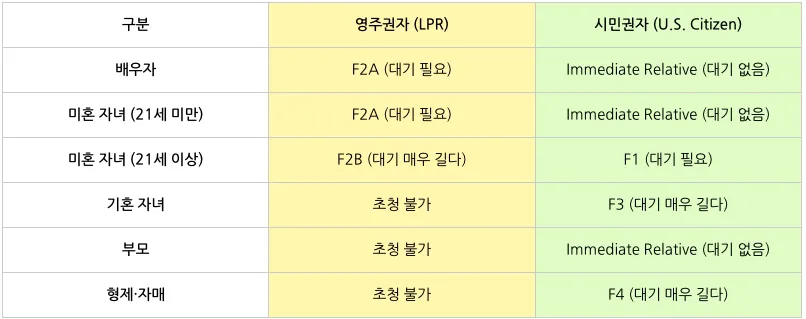
(1) Spouse and Unmarried Children Under 21 – F2A Category
- A permanent resident can sponsor a spouse in a legally recognized marriage and unmarried children under 21.
- In recent years, the Priority Date for the F2A category has tended to progress relatively quickly, but a certain waiting period still exists.
(2) Unmarried Children 21 or Older – F2B Category
- A permanent resident can also sponsor unmarried adult children 21 or older.
- However, the F2B category has a long waiting period, and actual immigration can take several years or more.
(3) Family Relationships That Cannot Be Sponsored
- Married children
- Parents
- Siblings
In other words, a permanent resident's sponsorship scope is limited to a spouse and unmarried children, and no other family members are eligible.
2. The Scope of Sponsorship After Becoming a Citizen
Once a permanent resident obtains citizenship, the scope of family sponsorship expands significantly.
(1) Spouse and Minor Unmarried Children – Immediate Relatives (IR)
- The spouse and unmarried children under 21 of a citizen fall under the Immediate Relative category.
- In this case, no Priority Date backlog applies, so an immigrant visa or permanent residency application can be filed immediately.
(2) Married Children – F3 Category
- A citizen can sponsor even married children.
- However, the F3 category has a long waiting period, and actual immigration often takes 10 years or more.
(3) Parents – Immediate Relatives (IR)
- After becoming a citizen, one can sponsor parents.
- Parents also fall under the Immediate Relative category, so there is no Priority Date backlog.
(4) Siblings – F4 Category
- A citizen can also sponsor siblings.
- However, the F4 category has the longest waiting period among U.S. family sponsorship categories, typically taking 10 to 15 years or more.
3. Comparison of Family Sponsorship: Permanent Resident vs. Citizen
 4. Strategic Considerations
(1) If Fast Sponsorship Is Desired, Obtaining Citizenship Is Advantageous
For sponsoring a spouse or parents, becoming a citizen places them in the Immediate Relative (IR) category, allowing the process to proceed without a waiting period.
(2) If Considering Long-Term Family Reunification, Converting to Citizenship Is Essential
To sponsor siblings or married children, one must become a citizen. Although the waiting period is long, this cannot even be attempted while holding permanent resident status.
(3) Priority Date and CSPA Must Be Considered
If a child being sponsored by a permanent resident turns 21, whether the child can still maintain eligibility depends on whether the Child Status Protection Act (CSPA) applies. This is a factor that must be reviewed when establishing a family sponsorship strategy.
5. Converting to Citizenship Is a Strategic Advantage
A permanent resident can only sponsor a spouse and unmarried children, but becoming a citizen greatly expands this scope to include parents, married children, and siblings. Furthermore, because a citizen's Immediate Relatives can obtain permanent residency without a Priority Date backlog, converting to citizenship is a strategically advantageous choice for those seeking long-term family reunification.