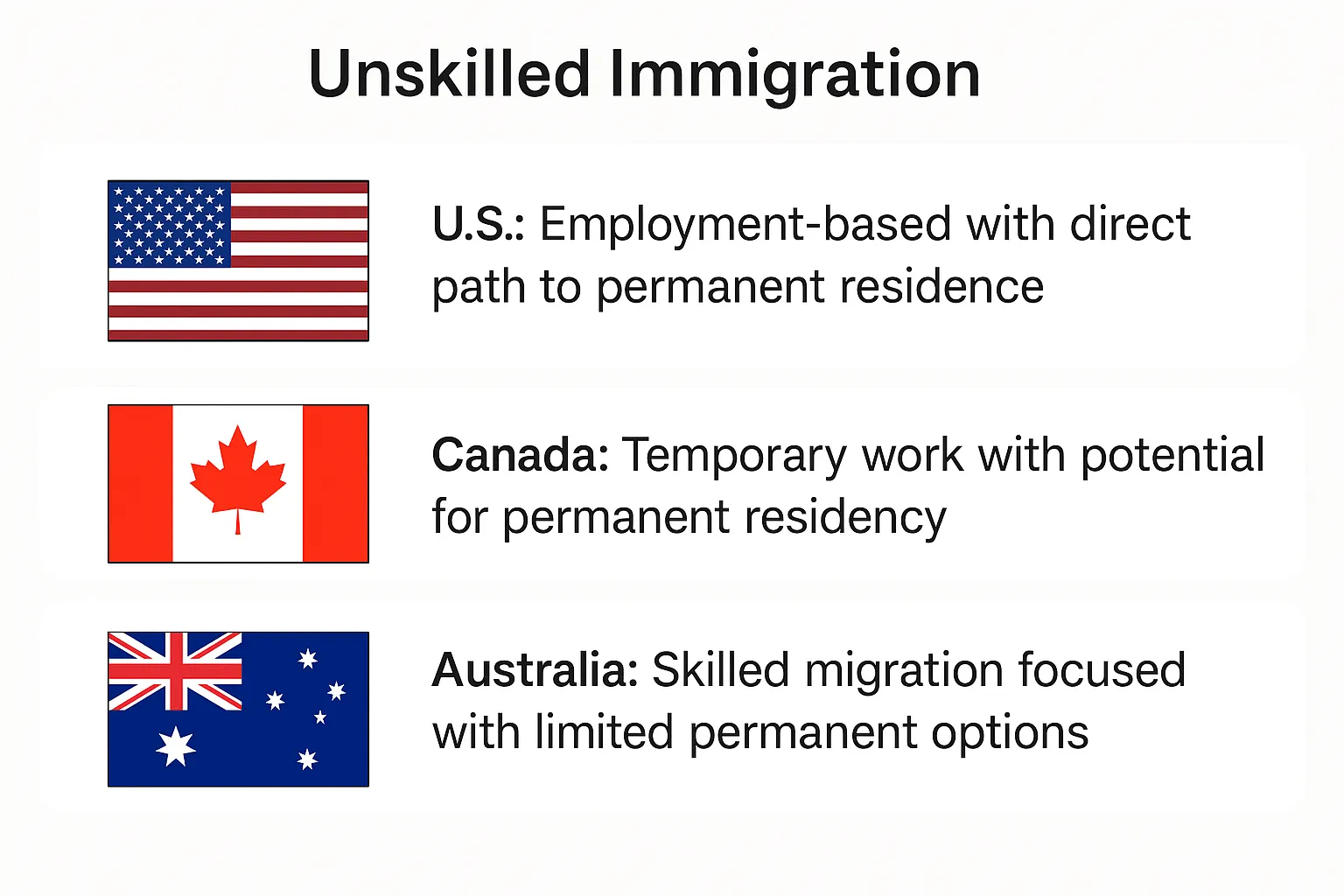
 The Direction of Labor Force Policy Determines the Character of the Immigration System
As global population aging and labor shortages intensify, 'unskilled immigration' is no longer simply a matter of manual labor but has become part of national competitiveness.
However, even under the same label of unskilled immigration, the way the United States, Canada, and Australia design their systems differs greatly. This difference stems not merely from screening criteria, but from each country's underlying philosophy toward labor.
■ United States: An 'Employment-Based System' Centered on Permanent Residency
Unskilled immigration in the United States is represented by the EB-3 Other Workers category. This system is structured so that the employer first proves the need to hire a foreign worker, and then files an immigrant petition (I-140) on that basis.
The core of this is “Labor Certification,” namely the PERM process. The employer must first prove that they looked for a worker within the United States who could do the same job, and only after passing this process can the foreign worker be given the opportunity for permanent residency.
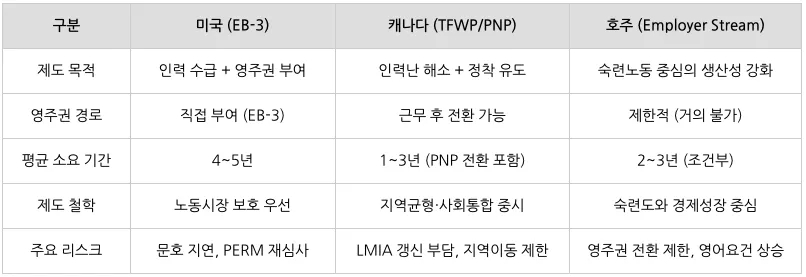
In other words, the United States follows a two-stage model of 'labor market protection first, then granting permanent residency.' It is nearly the only country where permanent residency is possible for unskilled positions, but the process is long (about 4 to 5 years) and access is restricted, so the focus is on institutional control rather than supply.
■ Canada: A Structure That Prioritizes 'Stay and Adaptation' Over Permanent Residency
Canada accepts unskilled foreign workers through the Temporary Foreign Worker Program (TFWP).
However, the goal of this program is not 'immediate labor input' but rather addressing regional labor shortages and assessing settlement potential.
The employer must prove through a Labour Market Impact Assessment (LMIA) that the position “cannot be filled by workers within Canada,” and after typically working for 2 to 3 years, the worker may attempt to convert to permanent residency through Express Entry, a Provincial Nominee Program (PNP), and similar routes.
In other words, Canada's structure is a gradual immigration model of 'temporary stay → adaptation assessment → conversion to permanent residency.' It does not offer workers a fast opportunity, but it is a generous system for long-term settlers.
■ Australia: A 'Skill-Biased' Structure Based on a Points System
Australia may appear on the surface to accept unskilled workers as well, but in practice it operates a points-based system centered on skilled migration.
Most unskilled workers enter through an Employer Sponsored Stream visa, and obtaining permanent residency is nearly impossible. In addition, if a temporary visa holder aims for permanent residency, they must accumulate additional points for experience, education, and English proficiency, so it is more accurate to describe this as a structure that effectively converts workers from unskilled to skilled.
Australia views foreign workers not as “a means of resolving labor shortages” but as “a driver of economic growth.” Accordingly, it places improving productivity and skill level as the top priority in designing its system.
■ Structural Comparison: The Three Countries Differ in 'Speed, Purpose, and Philosophy' of Unskilled Immigration
 ■ 'Labor Immigration' Is Not Simply a Job, but a Mirror of National Policy
The U.S. EB-3 system is structured to manage labor as a 'national resource,' Canada's model uses labor as 'a means of building community,' and Australia's system controls labor as 'a factor of economic efficiency.'
In the end, all three countries rely on foreign labor, but their approaches differ completely depending on policy philosophy. The United States opens its doors carefully through procedure, Canada gradually widens the door to immigration, and Australia manages the door based on points and skill level.
Understanding the structure of these three countries allows one to judge not simply “which is faster,” but “which fits the direction of my life.” In the end, unskilled immigration is not a matter of labor, but a matter of choosing a philosophy of settlement.