 A Complete Analysis of Entry Risks: ESTA, F Visa, J Visa, and More
Anyone going through the U.S. permanent residency process will, at some point, wonder about this.
“My green card hasn't been issued yet — can I still enter the United States on a nonimmigrant visa?”
This requires careful judgment, especially for those who need to travel between Korea and the United States while awaiting an interview or after filing an I-140 petition.
■ The Conflict Between Nonimmigrant Visas and 'Immigrant Intent'
U.S. visas are broadly divided into two categories.
- Nonimmigrant Visa: Student (F), Tourist (B1/B2), Exchange Visitor (J), ESTA, and others
- Immigrant Visa: A visa for permanent residency (Green Card)
The problem is that once an I-140 immigrant petition has been filed, the U.S. government considers that “this person already has immigrant intent.” As a result, there is a possibility of denial when newly obtaining a nonimmigrant visa or attempting to enter on ESTA.
■ Cautions When Entering on ESTA: The Riskiest Choice
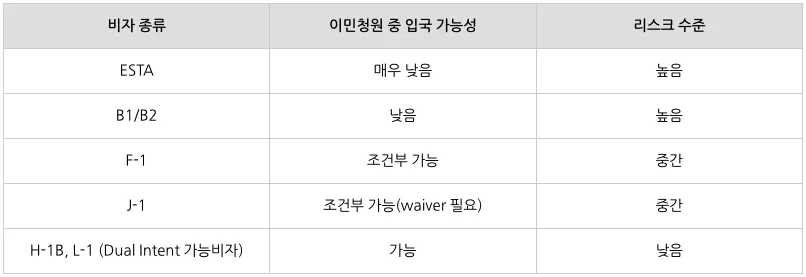
ESTA (visa-free entry) presumes a “short-term visitor with no immigrant intent.” However, if there is a record of a filed I-140, CBP (Customs and Border Protection) can verify this in their system. At the port of entry, you may be asked “Why are you entering visa-free while your immigration process is ongoing?” and if the explanation is not convincing, you may be subject to immediate Entry Denial.
Points of particular caution:
- If an ESTA entrant is denied, they are removed immediately and have no right of appeal.
- Under the “90-day rule,” filing an I-485 (adjustment of status) within 90 days of entry may be regarded as “concealing immigrant intent.”
Therefore, entering on ESTA is not recommended.
■ The Gray Area of F-1 (Student) and J-1 (Exchange) Visas
Both the F-1 and J-1 visas presuppose a “nonimmigrant purpose.”
However, if a previously issued visa is still valid, entry itself may still be possible even after an immigrant petition has been filed.
The problem lies at the port-of-entry inspection stage.
CBP may ask questions such as the following.
- “You're already in the permanent residency process — why are you coming to the U.S. on a nonimmigrant visa?”
- “Do you intend to return home once your studies or exchange program ends?”
A clear and consistent answer is essential here. For example, you must clearly explain your nonimmigrant purpose, such as “My spouse has filed an I-140, but I plan to complete my studies and return home.” After entry, you should be careful about the timing of filing I-485, since filing within 90 days may result in a finding that the nonimmigrant visa was misused.
■ An Additional Risk for J-1: The Two-Year Home Residency Requirement
Some J-1 exchange visitors are subject to a requirement (212(e)) to reside in their home country for two years after the program ends.
If this requirement has not been waived and the person proceeds to the permanent residency process, adjustment of status (I-485) or issuance of an immigrant visa is not possible.
Therefore, J-1 holders must be sure to obtain a 'waiver approval' (Form I-612 Approval Notice).
■ A Practical Alternative: Maintaining Lawful Status and 'Proper Timing'
If the I-140 has already been approved, it is safest to remain in Korea and wait for the National Visa Center (NVC) process.
Forcing entry on ESTA or an F visa during this period can result in entry denial or future disadvantages in visa screening.
On the other hand, if you are already lawfully present in the United States in a nonimmigrant status (F, J, H, etc.), continuing the process through I-485 adjustment of status is the legal and stable approach.
■ Conclusion: 'Consistency Between the Purpose of Entry and Current Status'
Entering on a nonimmigrant status while a permanent residency process is ongoing is not entirely prohibited by law, but even a small inconsistency can escalate into a major risk during actual screening.
Aside from dual intent visas, ESTA and tourist visas are particularly risky, while for F-1 and J-1, proving purpose and managing timing are key. To keep the entire timeline safe, the necessity of entry, alternative means, and application timing must be designed together; unnecessary entry attempts should be reduced through advance review, and where entry is unavoidable, a strategy that maximizes consistency of evidence and statements is required.