 A Realistic Comparison of Education Cost Savings and College Admissions Competitiveness Through EB-3 Immigration
For Korean parents pursuing an internationalized education, the options for their children's future are becoming increasingly diverse. In particular, early study abroad, international schools, and settling in the United States through family-based immigration have emerged as representative strategies. Among these, the EB-3 immigration program, despite its relatively low entry barrier, is drawing attention as a realistic alternative that can offer long-term educational investment benefits.
This column structurally compares Korean international schools with American public schools and analyzes why EB-3 immigration can be a strategic choice from an educational perspective.
1. Comparing Education Cost Structures: Hundreds of Millions of Won vs. Free Education
Korean international schools charge tens of millions of won per year in tuition alone, and when admission fees, building funds, after-school activities, and shuttle fees are included, the total cost across the entire K-12 course can reach 200 to 500 million won. In particular, some foreign-affiliated international schools require payment in foreign currency, which also carries exchange rate risk.
American public schools, on the other hand, operate on a tax-funded, tuition-free education system. As soon as an EB-3 immigrant enters as a permanent resident, their child can enroll free of charge in the local public school, and ESL (English as a Second Language) support, special education, and after-school programs are also mostly provided at low cost or free of charge.
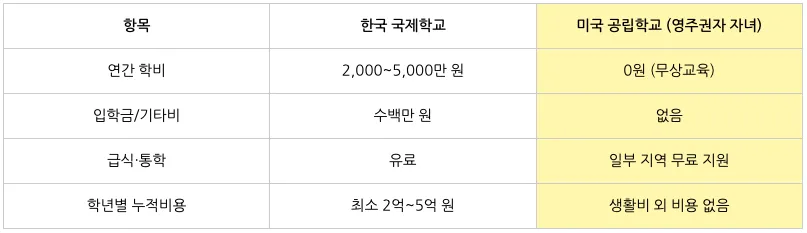
→ Conclusion: In terms of cost, American public schools have an absolute advantage over international schools, and aside from the initial immigration settlement costs, the long-term burden on the household is significantly lower.
2. Academic Credential Recognition and College Admissions Compatibility: Differences in System Design
Korean international schools generally adopt foreign curricula in part, but whether the diploma is recognized varies by school and curriculum. In U.S. college admissions, there are cases where diplomas from some international schools are evaluated unfavorably.
American public school diplomas, on the other hand, are fully compatible with the national college admissions system (FAFSA, Common App), and a variety of opportunities to demonstrate academic ability are provided through AP (Advanced Placement) or IB (International Baccalaureate) coursework.
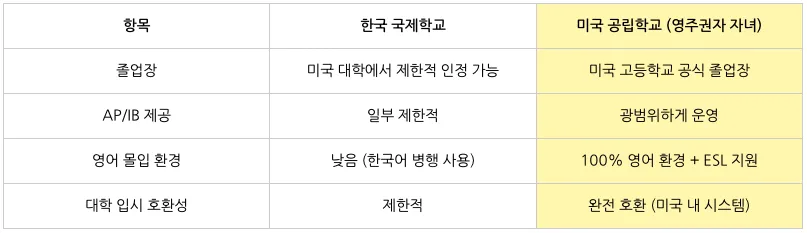
→ Conclusion: In terms of the reliability of academic credential recognition and consistency with the college admissions system, an American public school diploma is strategically far more advantageous.
3. Differences in Competitiveness for U.S. College Admissions: International Applicant Status vs. In-State Resident Status
The most critical difference lies in the classification of status at college admission and the resulting tuition differences.
A student who graduated from an international school in Korea is classified as an international student at U.S. colleges, and is subject to the following restrictions:
- No In-State tuition benefit
- Cannot apply for FAFSA (U.S. federal student aid)
- Requires an H-1B work visa after OPT
- Limited access to some scholarships or research positions
By contrast, a child who has settled in the United States through EB-3, as a permanent resident:
- Is eligible for In-State tuition (up to a 70% tuition discount)
- Can apply for FAFSA financial aid and Pell Grants
- Can seek employment freely after graduation (no status restrictions)
- Has the same access as U.S. citizens to opportunities such as ROTC and STEM research
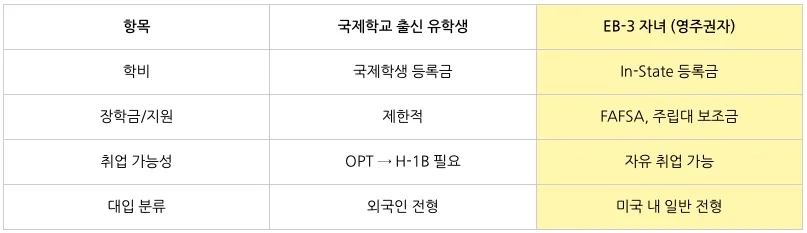
→ Conclusion: A child with EB-3 status starts from a structurally different position than an international student, not only in terms of tuition burden, but also admission opportunities, employment opportunities, and financial support.
4. The Strategic Significance of EB-3 Immigration: Reducing Education Costs and Securing Competitiveness Within the System
EB-3 immigration carries a meaning beyond simply 'obtaining permanent residency through labor.' From an educational perspective, it is a strategic route that simultaneously realizes the following two benefits:
- Access to a system that structurally reduces education costs (public schools, tuition discounts, scholarships)
- Establishing a long-term foundation for securing a child's academic credential recognition and college admissions competitiveness within the system
As a result, this can be seen as a path that maximizes the “ROI (return on investment) of costs invested in education.”
A More Practical 'Immigration-Based Education Strategy' Than International Schools
Short-term cost burdens may arise during the EB-3 immigration process, but in the medium to long term, this is a strategic choice that saves hundreds of millions of won in education costs while institutionally protecting a child's educational career.
If education is viewed not simply as 'sending a child to a good school,' but as designing a child's opportunities by leveraging a competitive environment and system, EB-3 can be a very reasonable and realistic answer.