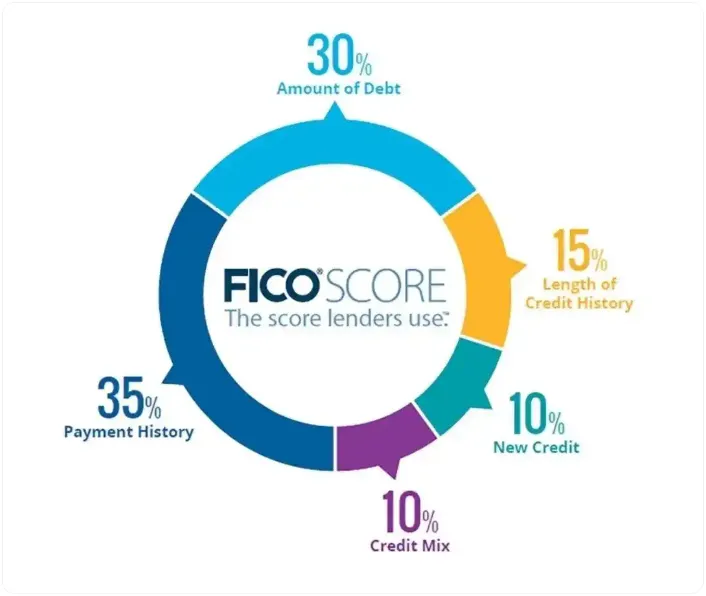
 In the United States, credit is evaluated not by the amount of money you have, but by the quality of your record. If you received your Social Security Number (SSN) right after getting your green card, the first thing to do is not 'spending' but 'credit design.' The credit score (FICO) formula may look complicated, but in practice it all comes down to consistently managing five factors — payment history, utilization (balance relative to card limit), average account age, credit mix, and credit inquiries. If you reduce mistakes and stabilize your patterns across these five factors, the 'interest rate' on an auto loan or mortgage can noticeably change within a year.
■ The First 90 Days: Focus on 'Opening a File,' Not the Score
In the United States, credit is evaluated not by the amount of money you have, but by the quality of your record. If you received your Social Security Number (SSN) right after getting your green card, the first thing to do is not 'spending' but 'credit design.' The credit score (FICO) formula may look complicated, but in practice it all comes down to consistently managing five factors — payment history, utilization (balance relative to card limit), average account age, credit mix, and credit inquiries. If you reduce mistakes and stabilize your patterns across these five factors, the 'interest rate' on an auto loan or mortgage can noticeably change within a year.
■ The First 90 Days: Focus on 'Opening a File,' Not the Score
With no credit history at all, a single secured card with a low approval barrier is the safest starting point. Link 3 to 5 small fixed expenses to this card — such as phone bills, streaming services, and transportation costs — and set up full auto-pay immediately after opening it to build the habit of 'zero late payments.' The goal at this stage is not cashback. It is to steadily accumulate reportable data that sends the market the signal that 'this person pays on time every month.' If you keep your balance right before the statement closing date within 10% of your limit (for example, $50 or less on a $500 limit), early volatility is reduced.
■ A Credit Card Is Not a Spending Button, but a 'Quiet Recorder'
Spending a lot and paying back a lot does not raise your score. What is directly reflected in your score is the balance reported on the closing date. The smaller the limit, the more restrictive it can feel, and the solution is mid-cycle payments. If you pay two or three times — once 3 to 5 days before the closing date and once right before the due date — a small limit can function like a large one. When you need to make a large purchase, it is advantageous to make it the day after the closing date and pay it off in full the day before the next closing date.
■ Months 3–6: Expand Your 'Space' with a Second Card
Having two cards increases your total limit, naturally lowering your utilization for the same spending. Wait at least 90 days after opening your first card, then apply for a no-annual-fee starter or student card. If you are approved, rather than immediately increasing your spending, it is better to calmly explore the conditions for a Credit Limit Increase (CLI). One thing to be careful about here is spacing out hard pulls (credit inquiries). Applying for cards no more than once per quarter helps you avoid point deductions from accumulated inquiries.
■ Credit Mix Is Completed by Balancing 'Revolving + Installment' Accounts
Credit cards are revolving accounts, while builder loans and auto installment loans are installment accounts. Having only cards leaves your profile structurally weak. Adding a credit builder loan (a small 12-month loan) in months 6 to 9 improves your credit mix and gives your score more 'depth.' Being added as an Authorized User (AU) on a family member's old, well-established account is another option, but if that card has late payments or high utilization, it will transfer directly to your own credit, so checking it beforehand is absolutely essential. AU status is only a supplementary tool — the principle that 1 to 2 accounts in your own name are the core does not change.
■ The Two Factors FICO Truly Values Most Are Payment History and Utilization
Countless tips circulate, but what actually has the biggest impact on your score is paying on time and keeping utilization low. A single late payment stays on your record for a long time, and a spike in utilization causes a sharp short-term drop. The solution is simple. Block the possibility of late payments at the source with full auto-pay, and control utilization with mid-cycle payments. For reference, VantageScore is commonly seen in consumer monitoring, but FICO (especially the mortgage 2/4/5 models) is still the standard for loan and mortgage underwriting.
■ If Your Goal Is a Mortgage, Design Today by Working Backward from Your 'Month-12 Status'
Most lenders prefer a profile with 2 to 3 on-time tradelines maintained for 12 months or more. At the same time, you need to keep your debt-to-income ratio (DTI) at 36% or below and be able to transparently document the source of funds for your down payment and closing costs. In months 9 to 12, it is safer to check your status in advance using the Mortgage FICO report actually used in underwriting, and to pause new debt such as auto loans. The trio of 'a good score + low DTI + sufficient cash reserves' is the key that unlocks the best interest rate.
■ The Trap Immigrants Often Fall Into Is Not the System, but Calendar Management
Most mistakes come not from a lack of information but from failures in schedule management. Common examples include no credit file being created because only a debit card was used, a 30-day late payment being recorded because auto-pay expired, and hard pulls accumulating from applying for multiple cards in a short period. Applying a triple safeguard of e-notifications plus auto-pay plus reminders to every bill prevents 80% of incidents through 'setup' alone. Small habits reduce large costs.
■ Disputing and Correcting Errors Is a Chore with Very High Return Relative to Effort for Your Score
Issues such as incorrectly reported late payments, wrong limits or balances, and long-closed accounts still showing as open can be corrected through the online dispute process with the credit bureaus (Experian, Equifax, TransUnion). Keeping evidence such as statements, payment confirmations, and customer service call records in a digital folder at all times makes a noticeable difference in processing speed and outcome. For delays under 30 days, it can also be worthwhile to ask the issuer for a **one-time goodwill adjustment (a discretionary removal by the financial institution)**. 'Organized evidence' is your strongest bargaining power.
■ The 12-Month Roadmap at a Glance
Months 0–3: Open one secured card → set up auto-pay for 3–5 small expenses → keep utilization within 10%.
Months 3–6: Apply for a second card (at least 90 days apart) → increase limit after approval (if possible) → space out hard pulls.
Months 6–9: Add an installment account via a credit builder loan → use AU status only with a 'completely flawless primary card.'
Months 9–12: Check your status with Mortgage FICO → keep DTI at 36% or below and secure cash reserves → refrain from new debt.
What sustains this roadmap is consistency rather than tricks. If you maintain the rhythm of 'small repeated use → lowering the balance before the closing date → full auto-pay' for 12 months, fluctuations in your score decrease, and your approval, limit, and interest rate conditions improve one step at a time each quarter.
■ Credit Is Not a Lucky Spike, but the Accumulation of Habits
Credit cannot be built with a single move. Instead, small, repeated, correct choices change your score and, in turn, your interest rate. The first year right after obtaining your green card is the season for building your basic strength. Start with a secured card, expand your space with a second card, supplement your mix with a small installment loan, and insist on zero late payments and 10% utilization throughout the entire process. This simple but tedious rhythm is ultimately the fastest path to mortgage pre-approval. Credit is not a number but the sum of habits, and that habit begins with today's $5 auto-pay.