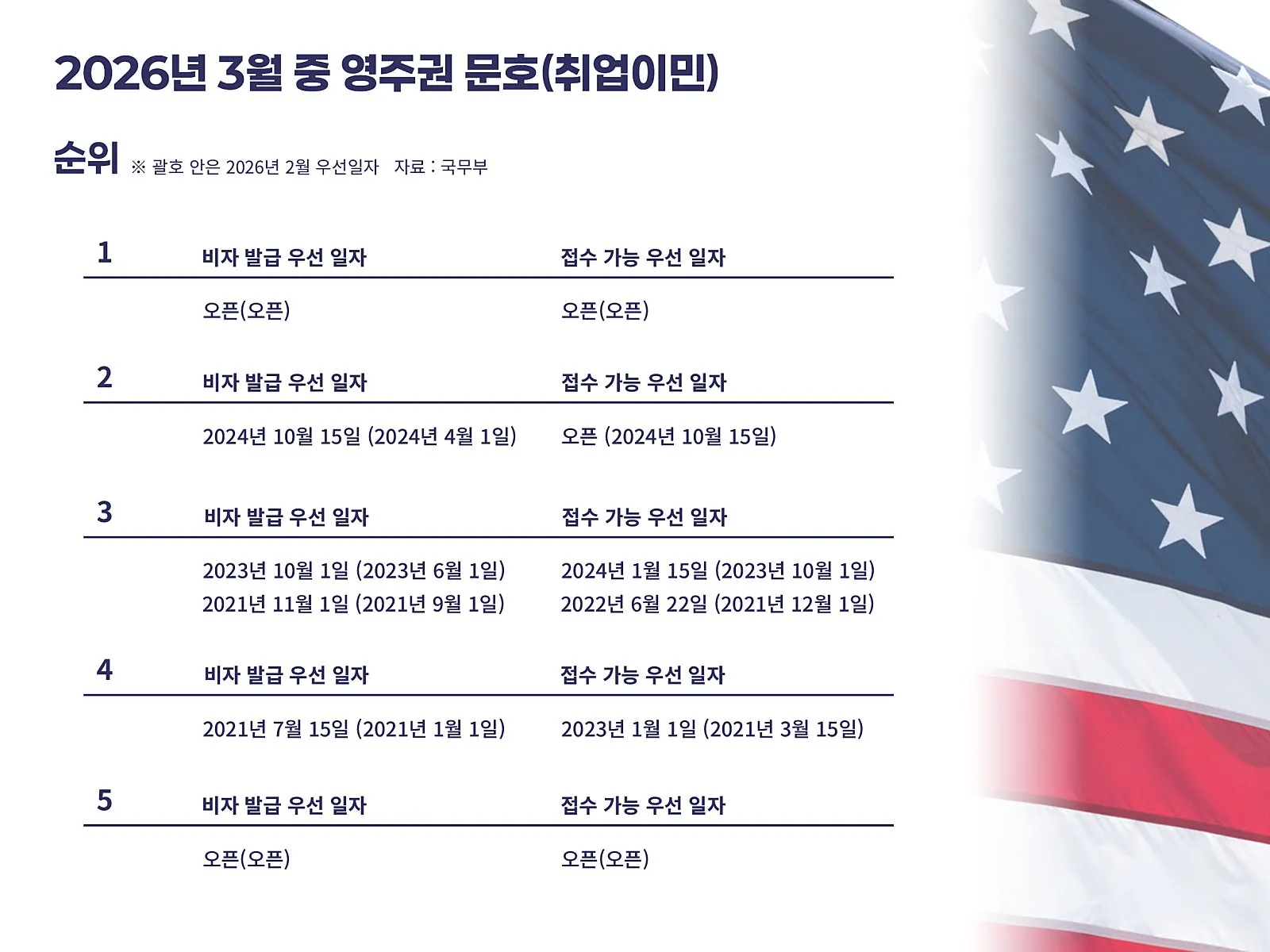
After working in immigration practice for a long time, the day the visa bulletin is published starts to feel a bit like the day exam results come out. Every month, you carefully check the numbers and calculate "how much movement was there this time." But the March 2026 bulletin had a different atmosphere. Rather than a simple "modest step forward," it showed a shift significant enough to actually feel.
In particular, the fact that the Dates for Filing cutoff for the employment-based second preference category (EB-2) switched to open (Current) carries meaning beyond just a number. Just a few months ago, there was still a substantial gap between an applicant's priority date and the cutoff date, and many applicants were effectively stuck in a holding pattern. This change shows that a portion of that stalled period has now been resolved.
■ Why the EB-2 Opening Is Getting Such a Big Reaction
EB-2 is a category primarily used by people with a master's degree or higher, or those in advanced professional occupations. Over the past few years, this category has continued to accumulate backlog alongside the rise in NIW filings. The biggest burden was the uncertainty of "I've filed, but I have no idea when I'll be able to move to the next stage."
The fact that the filing date has now opened up means that, as long as the requirements are met, applicants can move forward with I-485 adjustment of status or immigrant visa processing at the same time. For those inside the U.S., being able to apply for work authorization (EAD) and travel authorization (AP) together makes plans for both staying in the country and one's career far more stable. This isn't just a psychological sense of relief — it's a change that actually affects daily life.
What's important to note here, though, is that the bulletin can be adjusted again at any time. There have been several cases in the past where a surge in demand caused things to retrogress again. This progress is better understood not as a "permanent fix," but as a window of opportunity that needs to be used wisely.
■ The Overall Flow of Employment-Based Immigration Is Shifting
In this bulletin, progress appeared not just in EB-2, but across employment-based immigration as a whole, including EB-3 skilled and unskilled categories. This can be interpreted not as a simple administrative adjustment of numbers, but as a result that actively reflects demand accumulated over the course of fiscal-year visa operations.
Recent U.S. industrial policy views securing highly skilled talent in fields such as semiconductors, artificial intelligence, advanced manufacturing, and healthcare as an important strategic factor. The progress in the employment-based visa bulletin is not unrelated to these industrial needs. On the other hand, the fact that the family-based bulletin has seen relatively little change also tells us something about where the current center of gravity in the immigration system lies.
■ Is Now the Time to Wait, or the Time to Move?
When the bulletin makes a big leap forward, many people choose to "wait and see a little longer." But from a practical standpoint, it's far more strategic to secure your priority date and move forward with the process while the bulletin is open.
When the bulletin opens up, filing volume tends to surge. As a result, review delays or Requests for Evidence (RFEs) can increase. In the end, the outcome is determined not by speed, but by how thoroughly prepared the case is. A case that's already built with solid logic and evidence at the petition stage won't be shaken even amid volatility.
■ You Need to Read Beyond the Numbers
The March 2026 green card bulletin isn't simply an event where a date moved up. It's a sign that the backlog that has persisted for years is gradually easing, and a signal to employment-based immigration applicants that the time has come to seriously consider taking action.
The bulletin is an administrative indicator that changes every month. But the window during which opportunity stays open is often not very long. Rather than simply treating this progress as good news to enjoy, it's important to use it strategically.
In the end, the immigration process is a battle of timing and preparation. And right now is clearly a moment worth acting on.