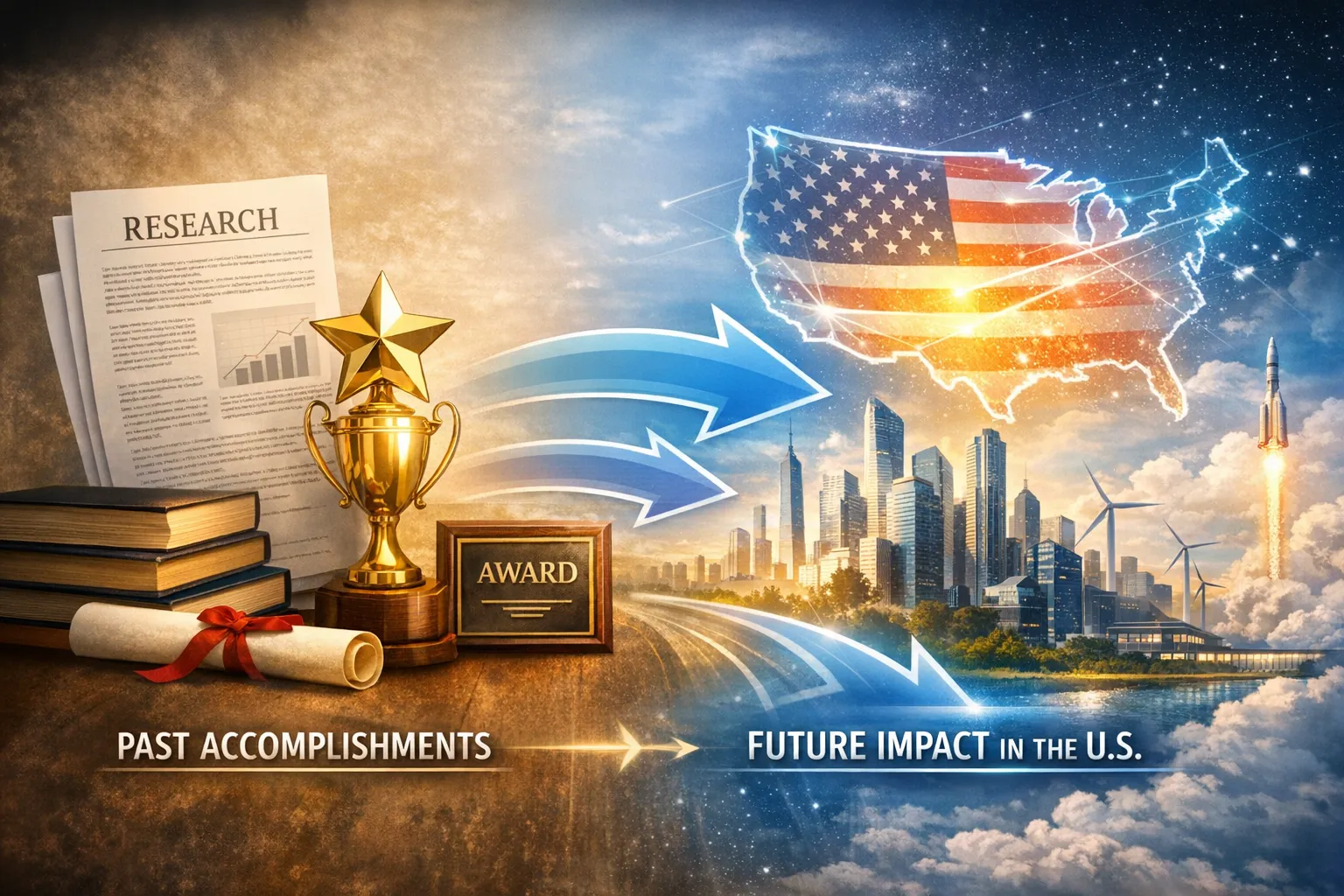
 Why Past Accomplishments Are Not Enough for an NIW Petition
Understanding a Common Misconception
Why Past Accomplishments Are Not Enough for an NIW Petition
Understanding a Common Misconception
Many professionals considering an EB-2 National Interest Waiver believe that a strong resume alone will qualify them for approval. Applicants often focus on their degrees, years of experience, publications, or awards, assuming that these achievements automatically demonstrate eligibility for NIW.
While past accomplishments are certainly important, they are only part of the picture. The legal standard for NIW is not based solely on what an applicant has already done. Instead, USCIS evaluates whether the applicant's future work in the United States will advance the national interest.
In other words, a strong background helps establish credibility, but it does not by itself satisfy the NIW standard.
The NIW Framework Is Forward-Looking
Under the current legal framework established in Matter of Dhanasar, USCIS evaluates three main factors. First, the proposed endeavor must have substantial merit and national importance. Second, the applicant must be well positioned to advance that endeavor. Third, on balance, it must benefit the United States to waive the normal job offer and labor certification requirement.
All three elements involve a forward-looking analysis. USCIS is not simply reviewing a resume and asking whether the applicant has done impressive work in the past. The agency is evaluating what the applicant plans to do in the United States and whether that work will meaningfully contribute to national interests.
Because of this, the proposed endeavor becomes a central part of every successful NIW petition.
Being in an Important Field Is Not Enough
Another common misunderstanding is that working in an important field automatically qualifies someone for NIW. Many applicants work in fields such as artificial intelligence, healthcare, biotechnology, engineering, or defense. These areas are widely recognized as important to the United States.
However, USCIS does not approve NIW petitions simply because the field itself is valuable. The agency must determine whether the applicant's specific work within that field will have broader impact.
For example, two individuals may both work in the same industry. One may perform routine job functions within a company, while another may be developing new analytical tools, designing policy frameworks, or advancing technologies that influence an entire sector. Even though both individuals work in the same field, only one may be able to demonstrate that their work rises to the level of national importance.
The key issue is not whether the field is important. The key issue is whether the applicant's proposed work within that field will contribute to the United States in a meaningful and scalable way.
Why NIW Requires More Than a Typical Job Role
Another reason past accomplishments alone are not sufficient is that the NIW category waives the normal labor certification process. In a typical employment-based immigration case, the employer must prove that there are no qualified U.S. workers available for the position. The NIW category removes that requirement.
Because of this waiver, USCIS must be convinced that the applicant brings something beyond what the normal labor market would provide. Simply being a competent professional working in a valuable field is usually not enough. The petition must show that the applicant is positioned to advance work that has broader policy, economic, technological, or public welfare implications.
This does not mean that applicants must be world-famous researchers or industry leaders. However, it does mean that the case must clearly demonstrate how the applicant's work goes beyond routine job duties and contributes to a larger national objective.
Connecting Your Past Achievements to Future U.S. Impact
Past accomplishments still play an important role in an NIW petition. Publications, patents, professional awards, leadership roles, and project experience all help demonstrate that the applicant has the expertise and credibility to advance their proposed endeavor.
However, these achievements must be connected to a clear explanation of future impact. USCIS wants to understand how the applicant's skills, knowledge, and experience will translate into meaningful contributions in the United States.
In successful cases, past work serves as evidence that the applicant is capable of advancing a well-defined endeavor that benefits the country. Without that connection, even an impressive resume may not be enough to meet the NIW standard.

