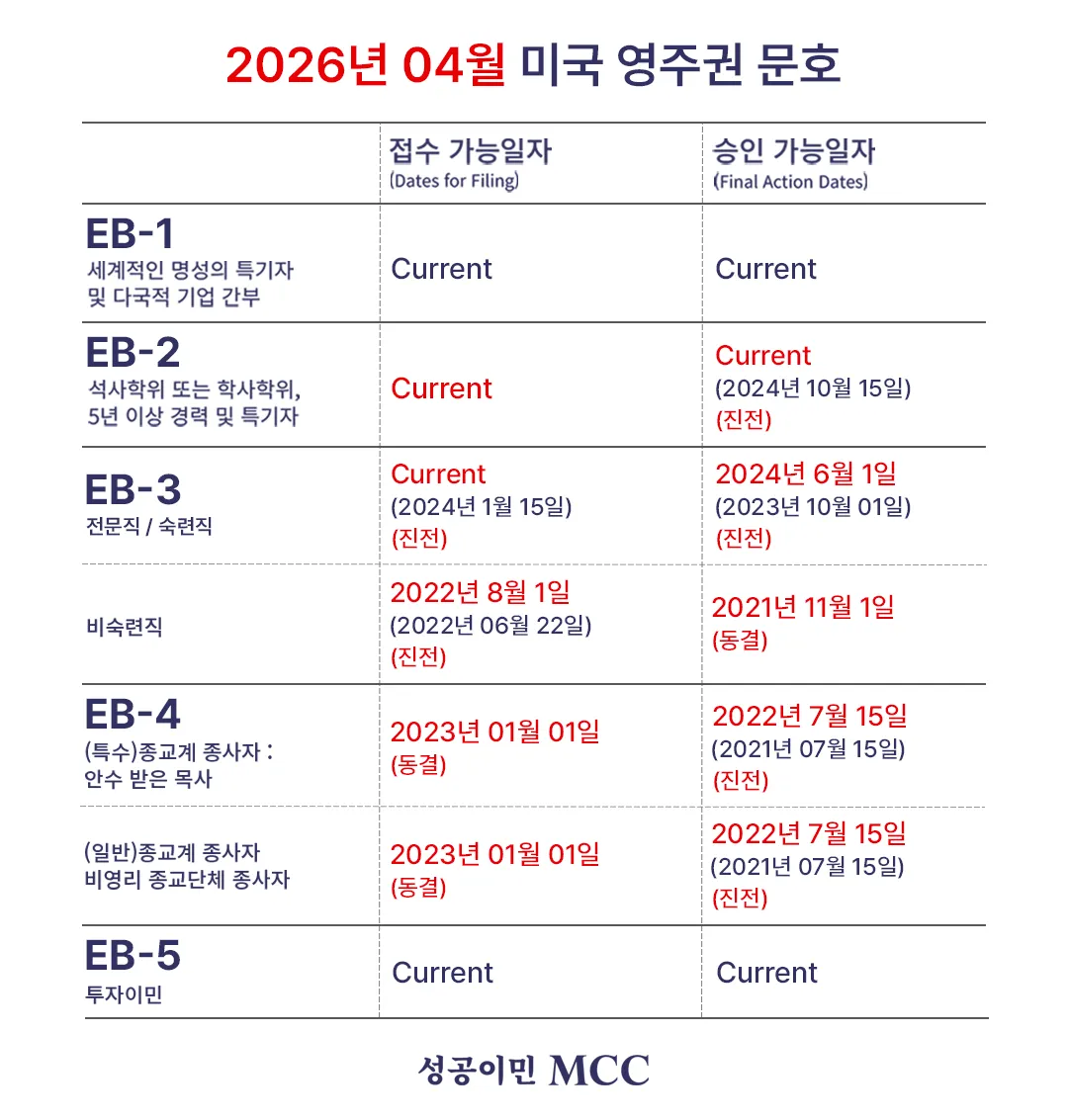
With the release of the April 2026 U.S. visa bulletin, a clear change has appeared in a flow that had been stalled for a long time. This bulletin matters all the more because it isn't a modest step forward — several categories were confirmed to be "open" at the same time. In particular, the fact that both employment-based and family-based categories saw across-the-board improvement can serve as an important turning point for those currently preparing to immigrate.
■ EB-2 Opens Fully, but Real Barriers to Entry Still Remain
The most notable change in this bulletin is EB-2. Not only the filing date but also the final action date shifted to "Current," creating a structure where, in theory, both filing and approval are immediately possible. Compared with the partial openings of the past several months, this is a highly unusual change.
In practice, however, this opportunity does not apply equally to every applicant. Immediate filing is possible only for those who already have an approved I-140, maintained status, and all supporting documents in place. Conversely, when preparation is incomplete, an open bulletin does not translate into actual progress. So it is more accurate to read this shift of EB-2 to "Current" not simply as an opportunity being handed out, but as a stretch where outcomes diverge sharply depending on how well one prepared in advance.
■ Acceleration for EB-3 Skilled Workers, Structural Stagnation for Unskilled
EB-3 also showed a marked change in this bulletin. For professionals and skilled workers, the final action date advanced substantially to June 1, 2024, and the filing date moved to "Current." This suggests that EB-3 skilled workers are effectively approaching processing speeds similar to EB-2. It amounts to a very favorable environment, especially for applicants at the PERM or I-140 stage.
Unskilled workers, on the other hand, remain on a limited track. The final action date stays at November 1, 2021, and only the filing date advanced slightly. This pattern reflects less a short-term slowdown than a long-term bottleneck rooted in demand concentrated in that category and in the annual quota structure. For anyone considering EB-3 unskilled, then, strategy needs to be built on the premise of structural waiting risk, not merely on bulletin movement.
■ EB-4 Enters a Recovery Phase While EB-1 and EB-5 Hold Steady
EB-4 appears to have entered a recovery phase, with its final action date advancing by nearly a year. This can be read as a positive signal that accumulated backlog is partly clearing. That said, the filing date remains frozen, which points to a stage that prioritizes processing existing cases over expanding new filings. Full normalization may still require additional time.
Meanwhile, EB-1 and EB-5 again held their "Current" status, continuing a stable flow. With EB-1, however, the recent upward trend in applicants is continuing, so an approach that also accounts for possible future bulletin movement is called for.
■ More Important Than "Timing" Is "Being Ready to Act Immediately"
With this bulletin out, many people are weighing "whether to start now or wait a while longer." But in a phase like the current one, the very approach of trying to predict timing carries little meaning.
A bulletin can retrogress at any time, and depending on international conditions or policy changes, it may shift faster than expected. In this kind of environment, "am I in a position to file right now" becomes a far more important standard of judgment than "when should I start."
■ This Bulletin Is Both an "Opportunity" and a "Sorting Stretch"
The April 2026 bulletin is clearly a moment when a window of opportunity has opened. But that opportunity does not work the same way for every applicant.
Those who are already prepared can move quickly to a result, while those who are underprepared may fail to use the opening even in the same bulletin environment. In the end, this bulletin is not simply a step forward — it can be seen as a "sorting stretch" that separates prepared applicants from unprepared ones.
What is needed now is not watching how the bulletin moves, but reviewing the overall picture — your priority date, your stage in the process, your immigration status, your family composition — and getting into a state where you can respond immediately.
The people who turn this bulletin into an actual result will not be the fastest ones, but the most prepared ones.