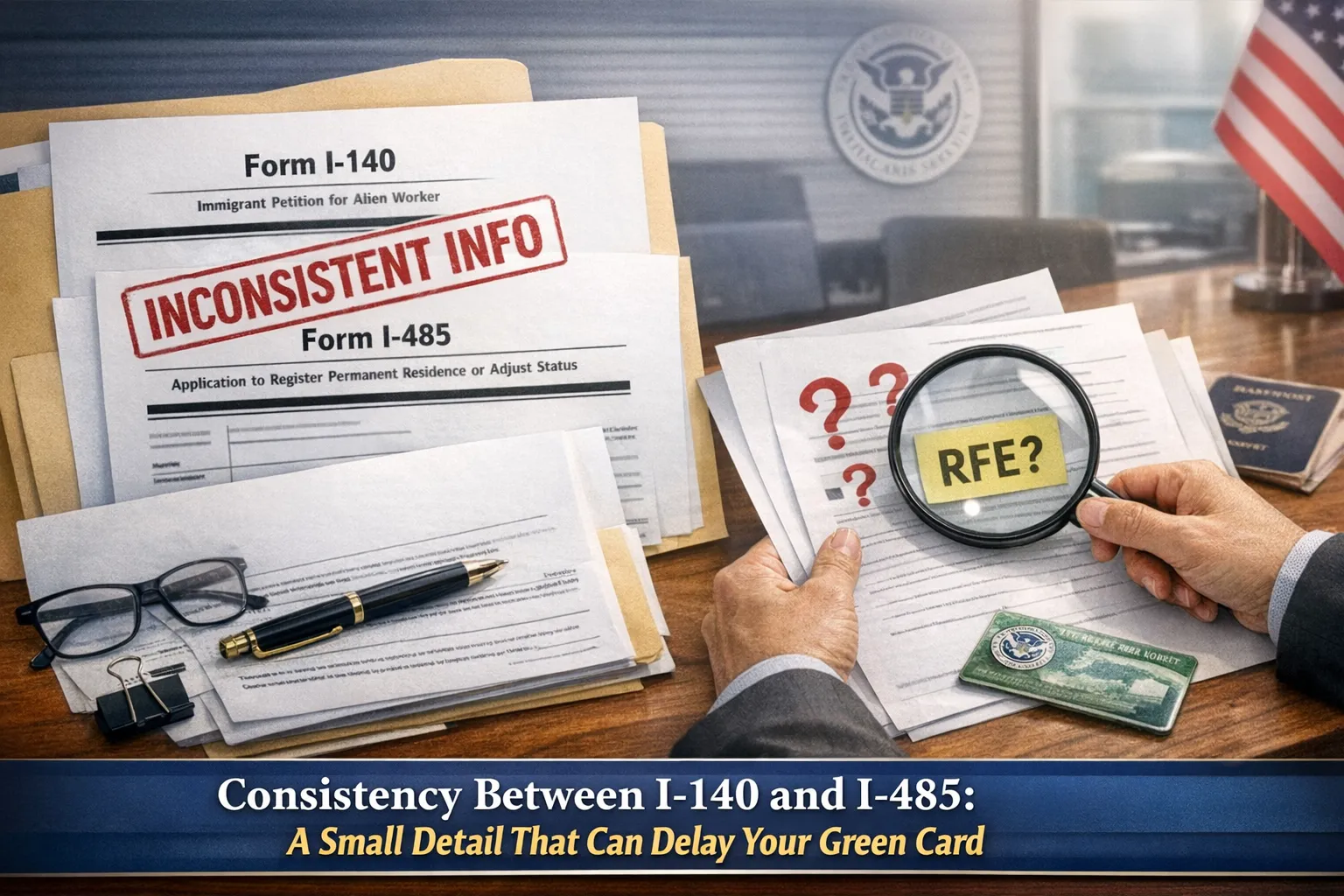
 Consistency Between I-140 and I-485: A Small Detail That Can Delay Your Green Card
With the Visa Bulletin becoming current for many applicants in March and April 2026, a large number of individuals are now moving from the I-140 stage to filing Form I-485. At this point, many applicants are revisiting information they previously provided and are realizing that certain answers were incomplete, simplified, or not entirely consistent with their current filings.
This is where an important issue arises: consistency between forms.
Why Consistency Matters
Both the I-140 petition and the I-485 application are submitted under penalty of perjury. Applicants are certifying that the information provided is true and correct to the best of their knowledge. When USCIS reviews a case, officers do not look at each form in isolation. They compare filings across the entire record.
Even small inconsistencies can raise questions. Differences in employment dates, job duties, addresses, prior immigration history, or even how certain facts were described can lead an officer to pause and ask for clarification. In many cases, this results in a Request for Evidence (RFE).
These issues are often not about major problems. They are about gaps, omissions, or answers that were initially provided too briefly.
Misrepresentation vs. Inconsistency
It is important to understand how USCIS may view inconsistencies. When information does not match across filings, it can be interpreted as a form of misrepresentation because the applicant has signed each form confirming its accuracy.
However, most of these situations are not willful misrepresentation. They usually arise from misunderstandings, memory gaps, translation issues, or the tendency to simplify answers during earlier stages of the process.
That distinction matters. A genuine mistake is very different from an intentional misstatement. But from USCIS’s perspective, the inconsistency still needs to be explained and resolved.
Why This Is Coming Up More Now
When priority dates were not current, many applicants focused primarily on getting the I-140 approved. Some details may not have seemed critical at the time, especially if they did not directly affect eligibility.
Now that adjustment of status is available, applicants must provide a more complete personal and immigration history on the I-485. This often brings earlier answers back into focus.
As a result, applicants are seeing prior responses again and realizing that certain information needs to be clarified or corrected. This is a normal part of the process, but it requires careful handling.
Practical Takeaway
Most inconsistencies are fixable and do not prevent approval. However, they can slow the case down if not addressed properly. An RFE can add months to the timeline and create unnecessary stress.
Before filing the I-485, it is worth taking the time to review prior submissions carefully. Make sure that dates, employment history, immigration records, and personal details are consistent. If something was incomplete or unclear in an earlier filing, it is better to address it proactively rather than wait for USCIS to raise the issue.
A careful review at this stage can help keep the process moving smoothly and avoid delays that are otherwise preventable.

