 More Important Than the Numbers in the Bulletin Is Reading the "Flow and Structure"
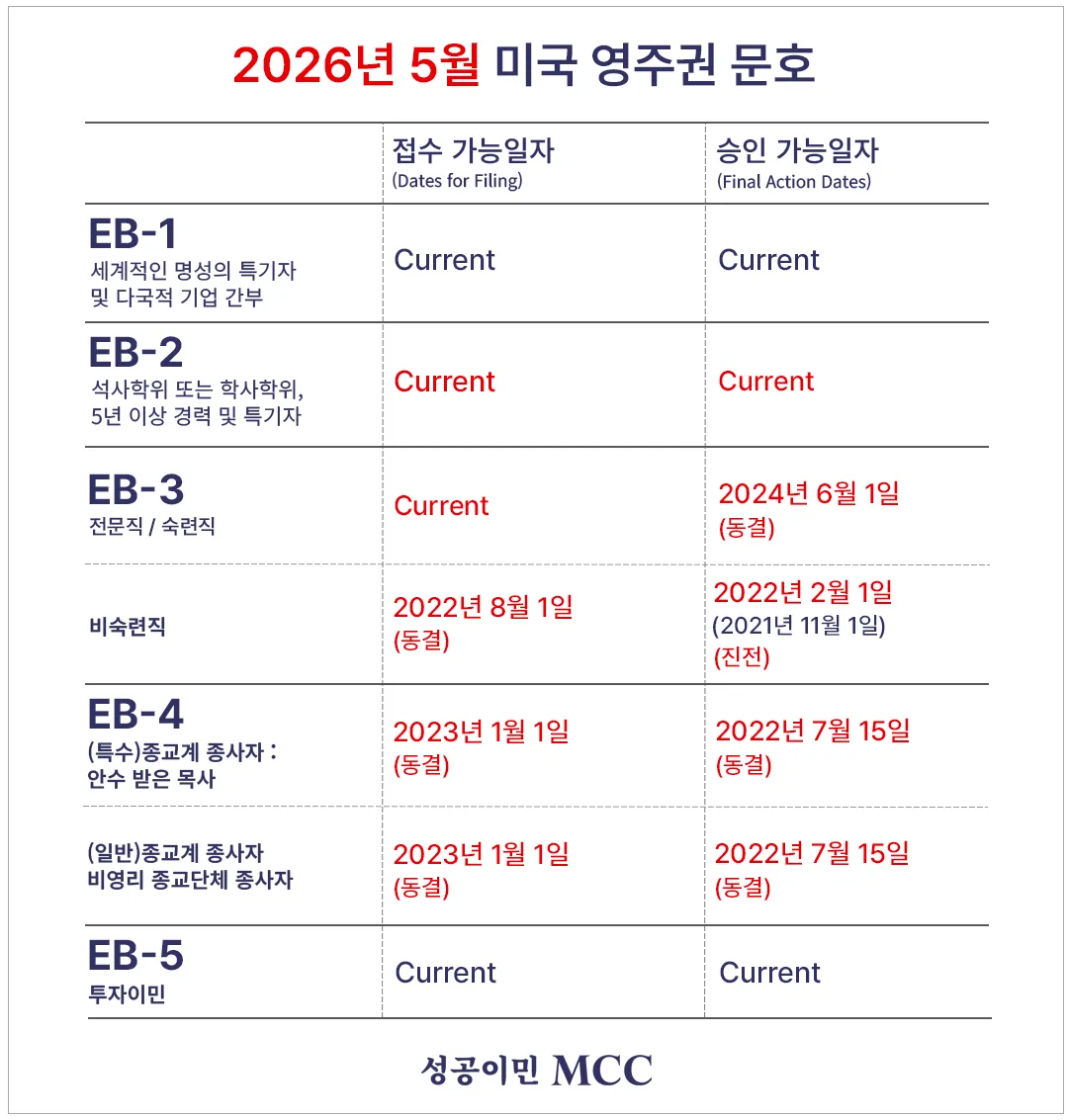
On the surface, the May 2026 U.S. visa bulletin shows a flow that holds steady without major change. But the key at this moment is not the movement of dates; it is reading at what speed and in what manner each category is operating.
The bulletin has entered a classic "speed differentiation stretch." Some categories remain effectively ready for immediate processing, while others have formed a clear waiting structure. In this kind of structure, what matters is not simply picking the fastest category, but setting an entry timing and a position that fit your own situation.
■ For EB-1 and EB-2, This Is a Matter of Execution, Not Strategy
EB-1 and EB-2 both hold "Current" status for final action dates and filing dates alike. Beyond simply meaning fast, this means a structure has formed in which filing can in theory lead to approval without delay.
EB-2 in particular carries significance because it has held a stable Current status for the past several months. Many applicants take the approach of "watching a little longer before deciding," but in a period like this that strategy can itself become a risk.
The bulletin is not a predictable system. If demand rises or a policy variable emerges, Current status can retrogress at any time. EB-2 has in fact seen repeated instances in the past where the bulletin suddenly closed or moved backward.
So for EB-2, and NIW especially, the key is not "when to start" but "when to finish preparing." In this stretch, the moment preparation is complete is the optimal moment to enter.
■ For EB-3 Skilled Workers, Securing Position Early Is Absolutely Critical
For EB-3 professionals and skilled workers, the final action date is fixed at June 1, 2024, while the filing date remains Current.
This structure is a textbook "waiting market." New filings continue to be accepted, but a certain gap in time exists before final approval.
The most important factor in this stretch is not speed but the priority date. In a green card process, the priority date is not merely a filing date — it is the key variable that determines the entire order of progression.
Many applicants choose the strategy of "entering once things speed up a bit," but in the EB-3 structure that judgment results in being pushed further back. The moment the bulletin advances, applicants who already secured earlier priority dates are processed first.
For EB-3 skilled workers, then, securing a priority date as early as possible is far more rational than waiting for timing. This is a category where "when you started" determines the outcome.
■ EB-3 Unskilled Is Slow, but It Shows a Living Flow
The most meaningful change in this bulletin is the advance in the EB-3 unskilled final action date. Moving roughly three months, from November 1, 2021 to February 1, 2022, is a signal that backlogged cases are in fact being processed.
Because this category is structurally an area of heavy demand and limited supply, rapid advancement is hard to expect. What matters, though, is that this is not a "frozen market" but a market that moves, however slowly.
Meanwhile, the filing date remaining at August 1, 2022 shows that control over new inflow is still in place. In the short term that acts as a speed limiter; over the long term it functions to prevent excessive backlog.
The essence of EB-3 unskilled is therefore clear.
This category is not a game of speed but a game of persistence.
What matters in this stretch is not "when it ends" but "whether you are already inside that flow." Over the long run, a difference in entry point creates a difference in outcome.
■ EB-4 Should Be Approached as a Structurally Stalled Market
EB-4 shows no change in either the final action date or the filing date. This needs to be read not as a temporary pause but as a category strongly affected, structurally, by supply limits and policy variables.
In this stretch it is difficult to expect short-term results from a new entry. The realistic strategy is to keep cases already in progress stable, while new applicants need to review alternatives in parallel.
■ EB-5 Remains a Stable Option With Its Own Independent Flow
Investment-based immigration (EB-5) again holds "Current" status in this bulletin. That is because, unlike the employment-based categories, it rests on a structure centered on investment capital and projects.
Since the recent program reforms in particular, stability and transparency have been strengthened for certain investment types (for example, regional center based investment), and the resulting increase in predictability is an important factor.
EB-5 has a barrier to entry in its capital requirement, but by the same token, when certain conditions are met, it allows for relatively stable progress. For anyone who values certainty and predictability over speed, it is a strategically very effective option.
■ In the End, Results Come Not From Speed but From the Order of Entry
Taking the May 2026 bulletin as a whole, one clear conclusion emerges.
This is not "a time for finding the fast lane." It is "a time for securing a position near the front."
EB-1 and EB-2 are an opportunity stretch you can act on immediately,
EB-3 is a structure that assumes waiting after entry,
EB-4 is stalled,
and EB-5 is stably open.
In this environment, a strategy of waiting for "better timing" is more likely to end in a missed opportunity. The bulletin can change at any time, but a priority date and a position already secured do not.
Immigration is not a question of short-term speed.
It is a question of long-term order and position.
The people who produce results a few years from now will not be the ones who made the fastest choice, but the ones who got inside the structure first.