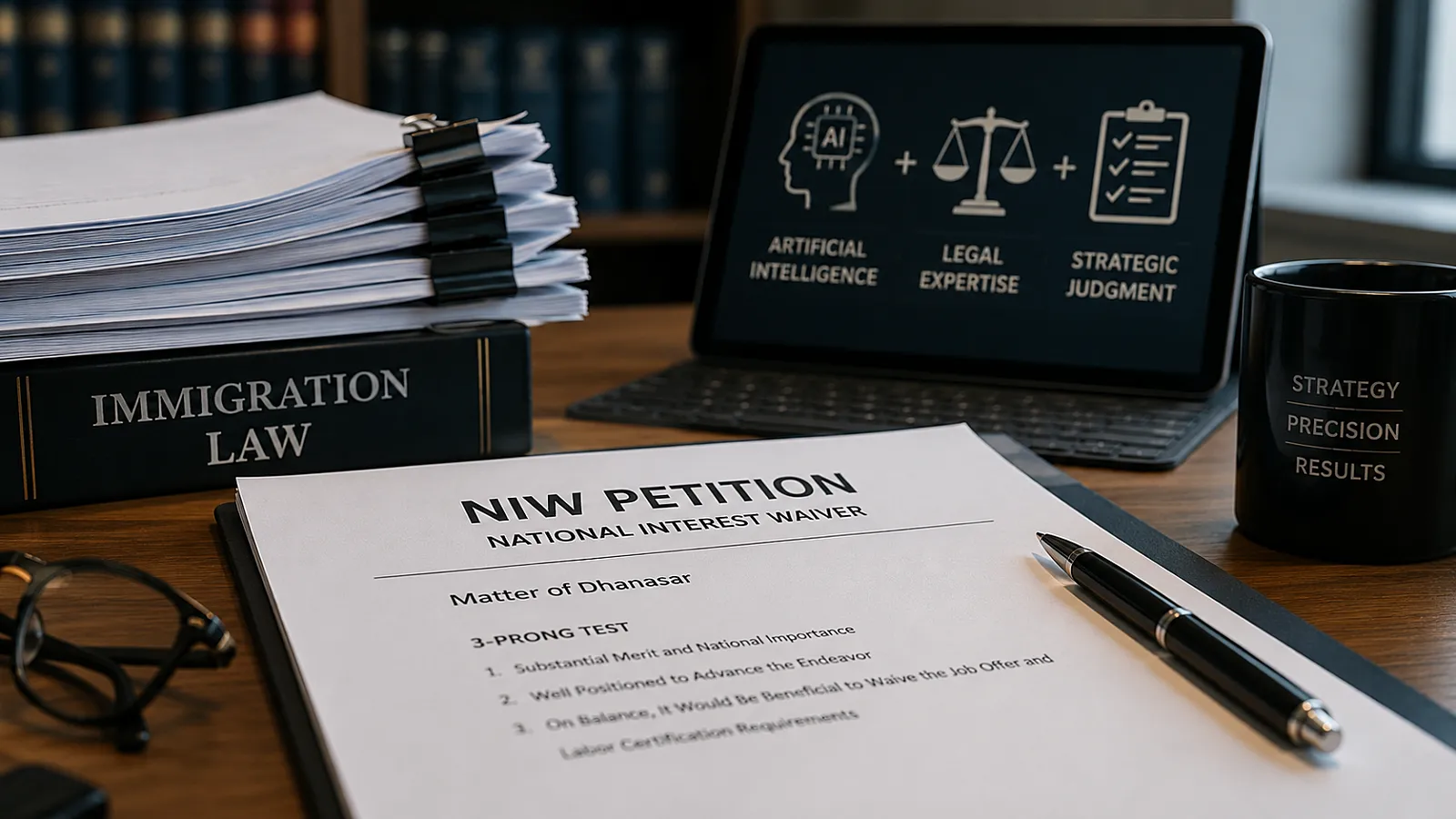
 Using AI for Your NIW Petition
In today’s high-stakes immigration landscape, a dangerous trend has emerged: overreliance on AI to draft National Interest Waiver (NIW) petitions. While AI is an impressive tool for basic tasks, using it to navigate the complexities of Matter of Dhanasar is proving to be a high-risk gamble. As an NIW practitioner, I am increasingly seeing the fallout from AI-generated NIW petitions. Here’s why relying on an algorithm to argue your national importance is often a recipe for denial.
Who Is Directing the Case?
To be clear, AI is not without its uses. In terms of sheer efficiency—such as formatting, summarizing long technical papers, or polishing prose—it is an impressive asset. The speed at which it can articulate complex sentences far surpasses that of a human. However, while AI is efficient at writing, it is not intelligent enough to generate the ideas itself. A successful NIW petition requires a strategist who understands the legal landscape. Every written document—from the petition letter and personal statement to the recommendation letters—presents an opportunity to incorporate specific legal arguments. This requires a high degree of planning and the use of precise phrasing that USCIS adjudicators are trained to look for. AI lacks the human intuition needed to appeal to a human reader or to create the concrete, tangible narratives that link technical research to the national interest of the United States.
The Prong One Confusion: Substantial Merit vs. National Importance
One of the most common mistakes AI makes is conflating Substantial Merit and National Importance. While both fall under the first prong of the Dhanasar test, they have distinct legal meanings. “Substantial Merit” focuses on recognizing the value of the field to the United States. It establishes that the endeavor itself is worthwhile and has a beneficial societal impact. National Importance focuses on the broader impact of your specific work. It assesses whether your particular proposed endeavor has significant potential to affect the country as a whole—for example, through the economy, national security, or public health. AI models often generate a generic argument regarding importance that fails to meet both requirements individually. A researcher may have work of incredible merit that simply lacks national importance as defined by USCIS. AI is not sophisticated enough to distinguish between these two burdens of proof on its own, resulting in a petition that appears vague to a human adjudicator.
The Teaching Trap: A Lesson in Legal Nuance
AI frequently conflates the general importance of a field with your individual contribution. I recently reviewed a petition for a client who had been denied after working with a firm that relied too heavily on AI automation. The firm’s selling point was using the latest AI to prepare NIW petitions. The AI had emphasized the client’s role as a university instructor. Any experienced practitioner knows that the precedent case specifically states that teaching, while having substantial merit, does not satisfy the “National Importance” prong because it is a localized benefit. Because that firm relied on AI logic rather than legal expertise, they highlighted a fact that was legally detrimental to the Dhanasar three-prong test, leading directly to a denial.
Meaningless Fluency vs. Convincing Writing
AI is incredibly good at constructing grammatically perfect sentences, but it is not capable of producing convincing writing. I have reviewed many first drafts created by applicants using AI that essentially lack meaning. They are filled with sophisticated-sounding sentences that fail to convey a clear, logical argument. Adjudicators become frustrated when documents lack conciseness. A wall of meaningless fluency often signals to an officer that the petition lacks substance. Even if a valid argument is presented, USCIS adjudicators will be less inclined to accept it if they must wade through long-winded text.
The Confidentiality and Training Gap
There is also an ethical reason why AI falls short at this level. Reputable immigration firms operate under strict confidentiality principles. Legitimate firms respect client confidentiality and do not feed actual documents to AI if there is a risk that they could be reviewed by third parties for large language model training. Consequently, AI models are mostly trained on a graveyard of lower-quality, DIY, or failed petitions. AI is not learning from elite practitioners; it is learning from low-quality examples.
A Tool
,
Not a Substitute
: AI is a tool, not yet a substitute for an experienced attorney. It can only produce output as good as the prompt it is given. If the person prompting the AI lacks an accurate grasp of the legal arguments and the logic used by human adjudicators, the output will be inherently flawed. If you are staking your future in the United States on a petition, ensure it is based on professional judgment and a deep understanding of USCIS precedents—not just an algorithm telling you what it thinks you want to hear.

...
