 Why Do
U.S. Employment-Based Immigration Programs Prioritize “Hiring Americans” Over “Foreign Nationals”?
Why Do
U.S. Employment-Based Immigration Programs Prioritize “Hiring Americans” Over “Foreign Nationals”?
One of the most common misunderstandings among those new to U.S. employment-based immigration is the Labor Certification (LC) process. During consultations, I hear these questions very often: “If the LC
is approved, doesn’t that mean I’m almost guaranteed a green card?” “
Why does the company even have to post a job ad?” “They’ve already
decided to hire a foreign national—so why are they re-evaluating the process of hiring a U.S. citizen?”
On the surface, this can seem quite strange. The company has already decided to hire a foreign national, and the applicant is ready to perform the job. Yet the U.S. government does not move directly to the next step. Instead, the very first question it asks is surprisingly simple: “Was it truly
difficult to hire a U.S. citizen?”
And the process of answering this very question is the LC.
■ LC IsNot a “Foreign National Screening” but a “Procedure to Protect the U.S. Labor Market”
Many people think of employment-based immigration as “a process to screen the qualifications of foreign nationals.” Of course, that’s true. However, the U.S. government first verifies one thing:
“Has this job been sufficiently made available to U.S. workers?”
This question is the starting point of the LC.
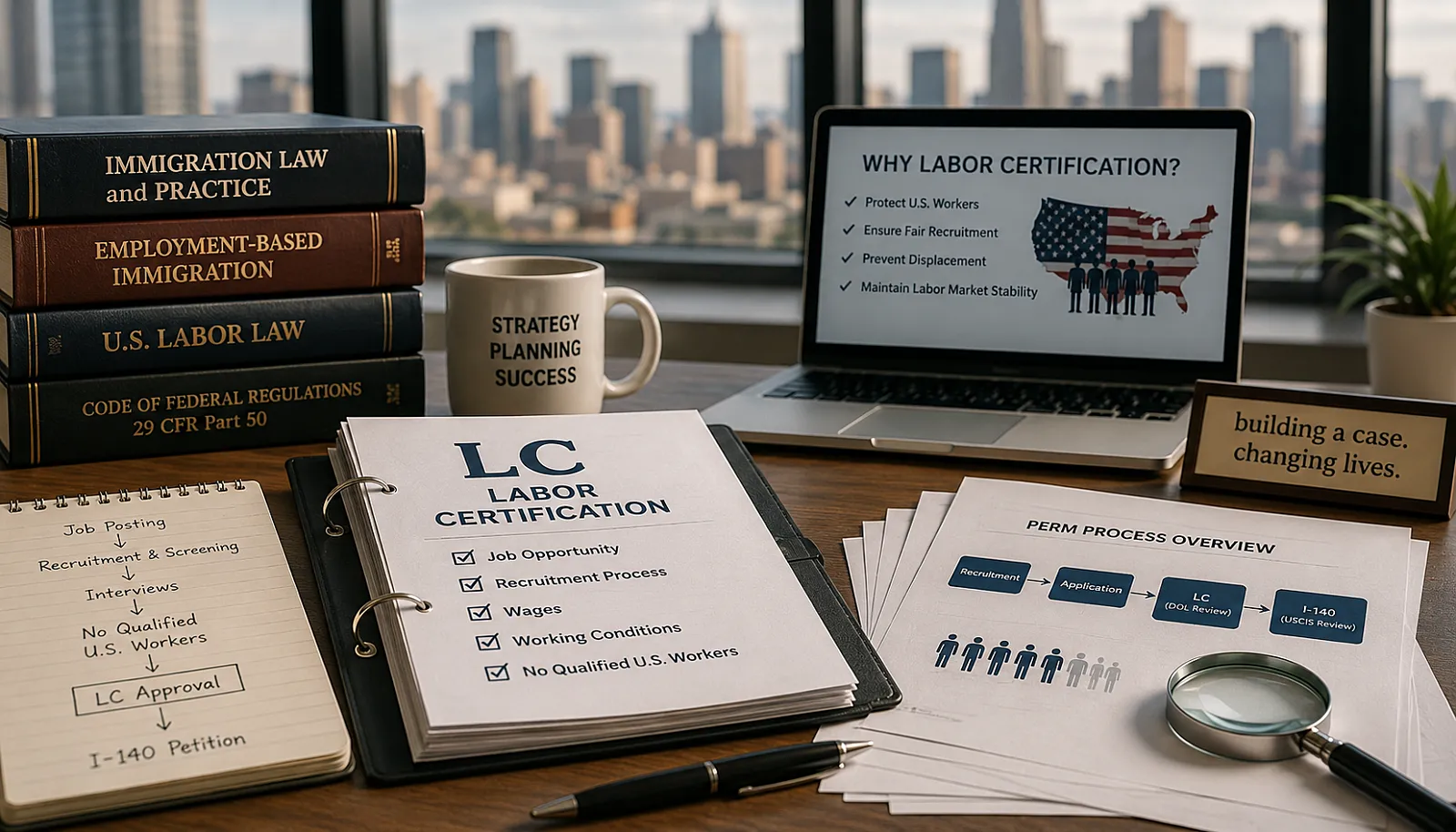
The LC is a procedure administered by the U.S. Department of Labor (DOL) that employers must complete before sponsoring a foreign national for a green card. Its purpose is clear: To ensure that green cards issued to foreign nationals do not infringe upon the opportunities of American workers.
In other words, the LC is not a stage where the applicant’s qualifications are evaluated first; rather, it is a procedure to review whether the U.S. labor market has functioned fairly.
Once you understand this point, the structure of why employment-based immigration is not merely a hiring process begins to become clear.
■ Why Doesthe U.S. Government Place Such Importance on “Advertising”?
Many people view the job advertisements required for employment-based immigration as a mere formality. However, from the Department of Labor’s perspective, these advertisements carry significant weight.
This is because they are not simply job postings; they serve as evidence that “we have actually attempted to hire U.S. workers.”
In this process, the Department of Labor examines several factors:
- Are the job requirements realistic?
- Are the required education and experience levels excessive?
- Is there any evidence of intentionally excluding U.S. workers?
- Does the offered wage level align with market standards?
- Is there a genuine intent to hire?
In other words, the Department of Labor reviews whether the structure of the advertisement itself was reasonable, rather than simply whether an advertisement was placed.
So, while the LC may appear to be an “advertising procedure,” it can actually be viewed as the initial stage for verifying the logic of the entire employment-based immigration case.
■ In practice
,
the most important factor isultimately the “Job Description.”
One of the most critical elements in the LC process is the job description. The direction of many cases is determined by this section,
because the Department of Labor uses the job description as the basis for assessing the “availability of U.S. workers.”
For example, if the requirements are excessively high, the Department of Labor may wonder, “Were the requirements deliberately set high to exclude U.S. workers
?”
Conversely, if the requirements are too low, the need for a foreign sponsor becomes less compelling.
In other words, the job description is not merely a document listing job duties.
It is a logical framework that explains “why this foreign national is needed” within the U.S. labor market.
Therefore, in practice, the stability of the LC depends heavily on how the job description is structured.
■ EB-2, EB-3 Skilled, Professional, and Unskilled Workers All GoThrough the LC Process
An interesting point is that, regardless of job level, most employment-based immigration cases go through the LC process.
Many people think: “EB-3
unskilled positions involve simple tasks, so why does the Department of Labor review them?” “
‘I’m in a professional position, so why do I have to prove that I went through the U.S. hiring process?’”
However, from the U.S. government’s perspective, the job level itself is not the key factor. The
core issue is this:
“What impact does it have on the U.S. labor market?”
Therefore, whether it’s EB-2, EB-3 skilled workers, professionals, or unskilled workers, the first step is to verify whether “sufficient consideration was given to U.S. workers.”
However, the review process varies slightly depending on the category.
- For EB-2, they examine how closely the applicant’s education and expertise align with the actual job duties
- For EB-3 professionals, they assess whether the degree requirement is essential for the job
- For EB-3 skilled workers, they evaluate whether the minimum two-year work experience requirement is reasonable
- For EB-3 unskilled workers, whether the actual labor demand and employment structure are realistic—
these factors are evaluated differently for each category.
In other words, while the LC process may appear similar across categories, it actually operates in entirely different ways for each one.
■ The LC is not just a starting point—it isthe “foundation.”
Many people view the LC as merely an “initial stage to get through quickly.” However, from a practical standpoint, cases where the foundation is shaky during the LC stage often lead to ongoing problems in subsequent stages.
This is because the LC is not merely a procedure for reviewing job postings; it is a stage for verifying the fundamental logic underpinning the entire employment-based immigration process.
- Why is this position necessary?
- Why are these qualifications required?
- Why was it difficult to hire a U.S. citizen?
- Why is a foreign sponsor necessary? If the answers to
these questions do not flow naturally, repeated explanations will be required even during the subsequent I-140 stage.
That is why, in practice, the LC is often described not as a mere preliminary step, but as the “foundation” of the employment-based immigration process.
If the foundation is shaky, the subsequent stages will ultimately be affected as well.
■ Ultimately, the essence of the LC is“balance.”
The U.S. employment-based immigration system is not merely a system designed to grant permanent residency to foreign nationals. It also serves the concurrent purpose of protecting the U.S. labor market.
The LC is precisely where these two objectives converge.
It is a process that verifies whether opportunities are being opened up for foreign nationals without infringing on the opportunities of U.S. workers.
That is the very essence of the LC.