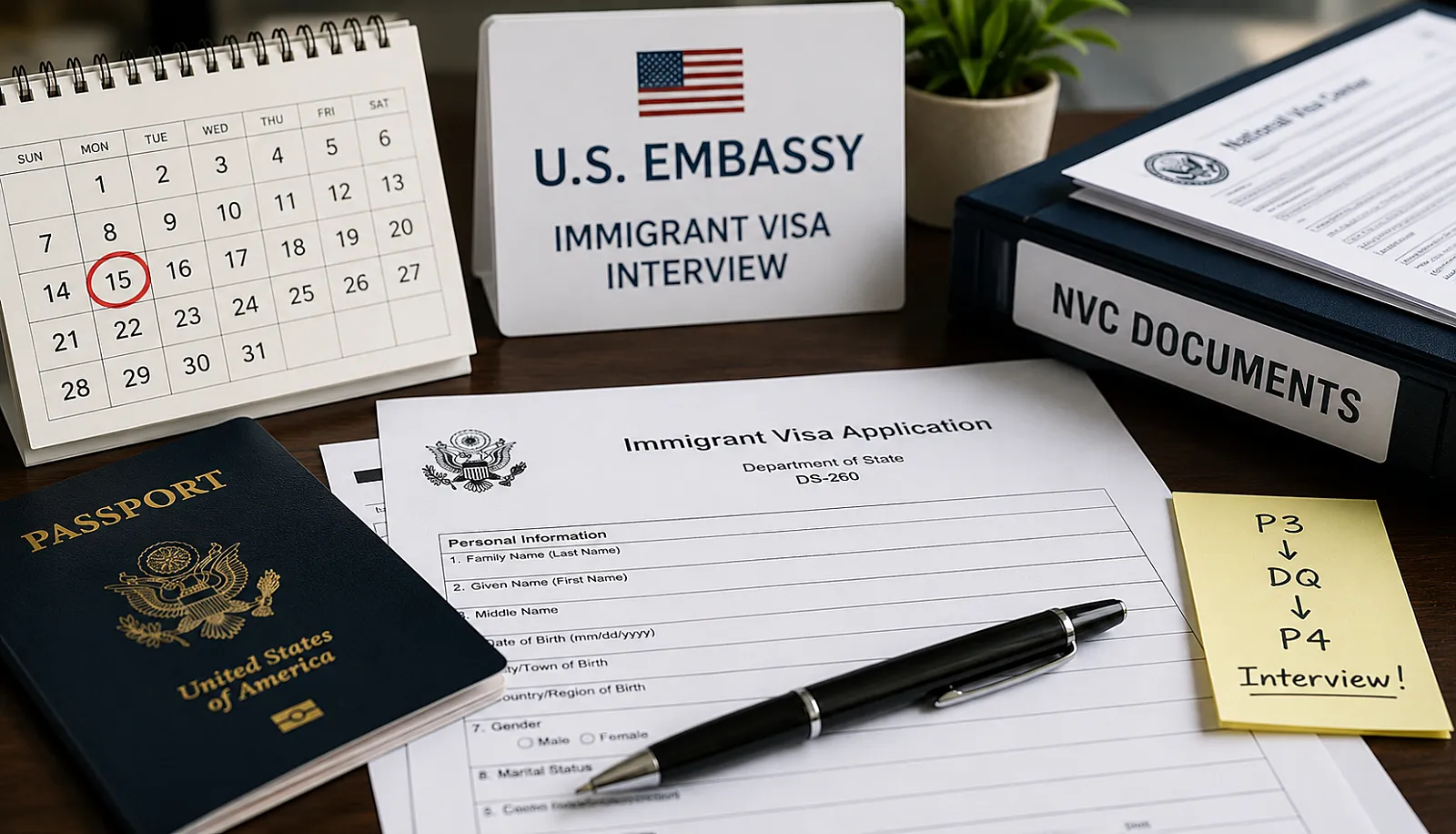
 A Complete Guide to the NVC Stage of U.S. Employment-Based Immigration: How Are Interviews Scheduled
After Receiving a DQ
A Complete Guide to the NVC Stage of U.S. Employment-Based Immigration: How Are Interviews Scheduled
After Receiving a DQ
? There is a point in the U.S. employment-based immigration process that many applicants find particularly frustrating: right after receiving a DQ (Documentarily Qualified) status at the NVC stage.
This is because, even after submitting Form DS-260, uploading all criminal history records and family relationship documents, and receiving a “Document Review Complete” status from the NVC, it’s still difficult to schedule an interview.
At this point, many applicants begin asking similar questions: “Why
hasn’t my interview been scheduled yet?” “
When will P4 be issued?” “What criteria are used to determine the interview
date?”
In particular, employment-based immigration categories—such as general EB-2, EB-3 skilled/professional workers, and EB-3 unskilled workers—are all directly influenced by the priority date and the Visa Bulletin; therefore, interview schedules are not determined solely by the “order in which documents are submitted.”
In fact, interview schedules (P4) are determined within a highly structured system where the priority date, the Visa Bulletin, embassy interview slots, and the State Department’s visa processing status all interact. Once you accurately understand this structure, it becomes much clearer why some cases get scheduled for an interview quickly, while others face long wait times.
■ Why Isn’tthe Interview Scheduled Immediately After I-140 Approval?
This is the very first point that confuses many applicants: “My I-140
was approved, so why isn’t the process over yet?”
This is a very natural question. However, the U.S. employment-based immigration system is much more structured than one might think.
I-140 approval is the stage at which U.S. Citizenship and Immigration Services (USCIS) approves that “this
employment relationship qualifies as an employment-based immigration sponsorship.”
In other words, it acknowledges that the employment relationship between the employer and the applicant, which is the basis for permanent residency, is valid.
However, the actual issuance of immigrant visas is handled by the U.S. Department of State (DOS). Therefore, once the I-140 is approved, the case is automatically transferred to the National Visa Center (NVC), an agency under the Department of State.
From this point on, the process shifts from a simple USCIS review to consular processing for actual entry into the United States. In other words, I-140 approval is not the end; it is more like a “gateway to the visa issuance stage.”
■ The key to the NVC stage is“final verification.”
Many people view the NVC stage as merely a process of transferring documents. However, this is not actually the case.
The NVC stage is essentially the phase in which the U.S. government conducts its final comprehensive verification of the applicant.
During this process, the review goes beyond simply verifying employment eligibility; it involves a comprehensive assessment to ensure there are no issues preventing the applicant’s actual entry into the United States.
The following factors are typically reviewed:
- Identity and
family relationships - Criminal history
- Military service
history - History of immigration law violations -
Health status and presence
of communicable diseases In other words, if the I-140 was an “employment-based review,” the NVC stage is the stage where the “actual eligibility to enter the U.S.” is finally assessed.
That is why many applicants describe this stage as feeling like “the real green card review has finally begun.”
■ The P3 Letter Marks the Startof the Actual Immigrant Visa Application Process
Once the I-140 is approved and a case is created at the NVC, the applicant is assigned a case number. Subsequently, the NVC typically sends a P3 (Packet 3) letter.
Simply put, this stage is an official notification stating, “You may now
begin the actual immigrant visa application process.”
From this point on, the applicant proceeds with the full visa process through the CEAC (Consular Electronic Application Center) system.
This typically includes the following steps:
-
Completing the DS-260 online immigrant visa application -
Paying the immigrant visa fee - Submitting civil documents related to birth and marriage
- Submitting a criminal history certificate-
Uploading a copy of your passport- Submitting military service records (if applicable)
Currently, most applications in South Korea are processed via the CEAC online upload system, and you must bring the original documents with you on the day of your interview.
In other words, starting from the P3 stage, the process moves beyond mere preparation and the actual immigrant visa application begins in earnest.
■ What Does DQ (Documentarily Qualified) Mean?
Once the applicant submits the DS-260 and all supporting documents, an NVC officer reviews them.
If all documents are deemed acceptable, the case is designated as DQ (Documentarily Qualified).
The meaning is simple:
““preparation for the interview is complete in terms of documentation.”
However, many applicants have a significant misunderstanding at this point. Becoming DQ does not mean an interview appointment is scheduled immediately.
DQ simply means that you are eligible for an interview; an actual interview date will only be assigned once all of the following conditions are met:
- Priority date becomes current -
Visa quota is
met - Embassy interview slot is
secured - Monthly visa allocation quota from the State Department is
available In other words, DQ status does not signify “final completion”; rather, it means you have entered the interview queue.
■ How Isthe Interview Schedule (P4) Determined?
The interview schedule (P4) is not determined solely by DQ order.
The most important criterion is ultimately the priority date. The U.S. employment-based immigration system is fundamentally a “first-come, first-served” structure, and the priority date is the criterion that determines your place in line.
In other words, interviews are not scheduled simply because the paperwork is complete; the most important factor is whether “your turn has actually arrived.”
In particular, the EB-2 and EB-3 categories are directly subject to visa quota restrictions. Therefore, the Visa Bulletin has a significant impact on interview scheduling.
For example, even if the Dereliction of Duty (DQ) process has already been completed, an interview will not be scheduled if the priority date has not yet opened according to the Visa Bulletin. Conversely, if the Visa Bulletin is sufficiently open and interview slots are available, a P-4 notice may be issued relatively quickly.
■ Why Are Interviews Clustered in Some Months but Scarcein Others?
From our experience on the ground, we observe that interviews are sometimes scheduled in clusters during specific periods, while at other times there is almost no activity.
This, too, is not mere coincidence.
The U.S. Embassy in Seoul has a limited number of interviews it can process each month. Additionally, various visa categories—such as student visas (F-1), tourist visas (B1/B2), family-sponsored visas, and investor visas—share the same interview resources.
In other words, interview slots themselves are a limited resource.
This is further influenced by the U.S. Department of State’s monthly visa allocation strategy. In some months, employment-based immigration interviews increase, while in others, they decrease relatively.
Therefore, interview scheduling is not simply a matter of individual cases but is determined within the broader U.S. visa processing system.
■ The P4 Letter IsEssentially the Ticket to the Final Hurdle
Once the priority date becomes current and an interview slot is assigned, the NVC sends the final P4 (Packet 4) letter.
From this point on, applicants begin preparing for the actual interview.
The following preparations are particularly important:
-
Scheduling a medical examination at a designated clinic - Final
review of original documents -
Preparing the most recent criminal history record -
Verifying passport validity - Preparing
tuberculosis (TB) records In particular, for applicants from South Korea, the tuberculosis (TB) test is a very important factor. If you have a history of tuberculosis treatment or abnormal X-ray findings, visa issuance may be delayed due to additional testing.
Therefore, in the final stages leading up to the interview, managing your health records is just as important as preparing your documents.
■ The interview is not an English test but a“fact-checking process.”
Many applicants are overly apprehensive about the interview itself. However, the core focus of an employment-based immigration interview is not an assessment of English proficiency.
The consular officer primarily verifies the following:
- Whether you genuinely intend to work
- Whether you understand the employer’s information -
Whether your family relationships are genuine -
Whether
there are any past violations of immigration law In other words, the most important factor is not complex English proficiency, but whether the documents you submitted and the content of the interview align naturally.
In fact, during the interview, it is far more important to provide “consistent explanations” than to be a “good speaker.”
■ Ultimately, interview schedules are determinedby a “system,” not by “waiting”
Many applicants view the wait for an interview simply as a matter of wondering, “Why is this taking so long?” However, in reality, P-4 interview schedules are determined within a highly structured system.
Priority dates,
visa availability,
DQ status,
embassy interview slots,
and the State Department’s visa processing policies
—all these factors must align simultaneously for an interview date to be assigned.
Therefore, a delay in scheduling an interview does not necessarily indicate a problem. In most cases, it is not an issue with the individual’s case but rather a normal part of the overall visa system’s workflow.
■ The P4 Letter Is Not Just a Scheduling Email—It Is the “StageImmediately Before Final Approval”
In U.S. employment-based immigration, the P4 letter is not merely an interview notification email.
It is the final stage reached only after all of the following conditions are met: I-140 approval,
completion of document review by the National Visa Center (NVC),
assignment of DQ status,
opening of the priority date,
and securing
an interview slot.
In other words, P4 signifies that you have entered the stage immediately preceding the actual issuance of an immigrant visa, rather than simply being a booking confirmation.
The moment you accurately understand this process, you’ll begin to see a realistic timeline and strategy instead of feeling vague anxiety.
...
