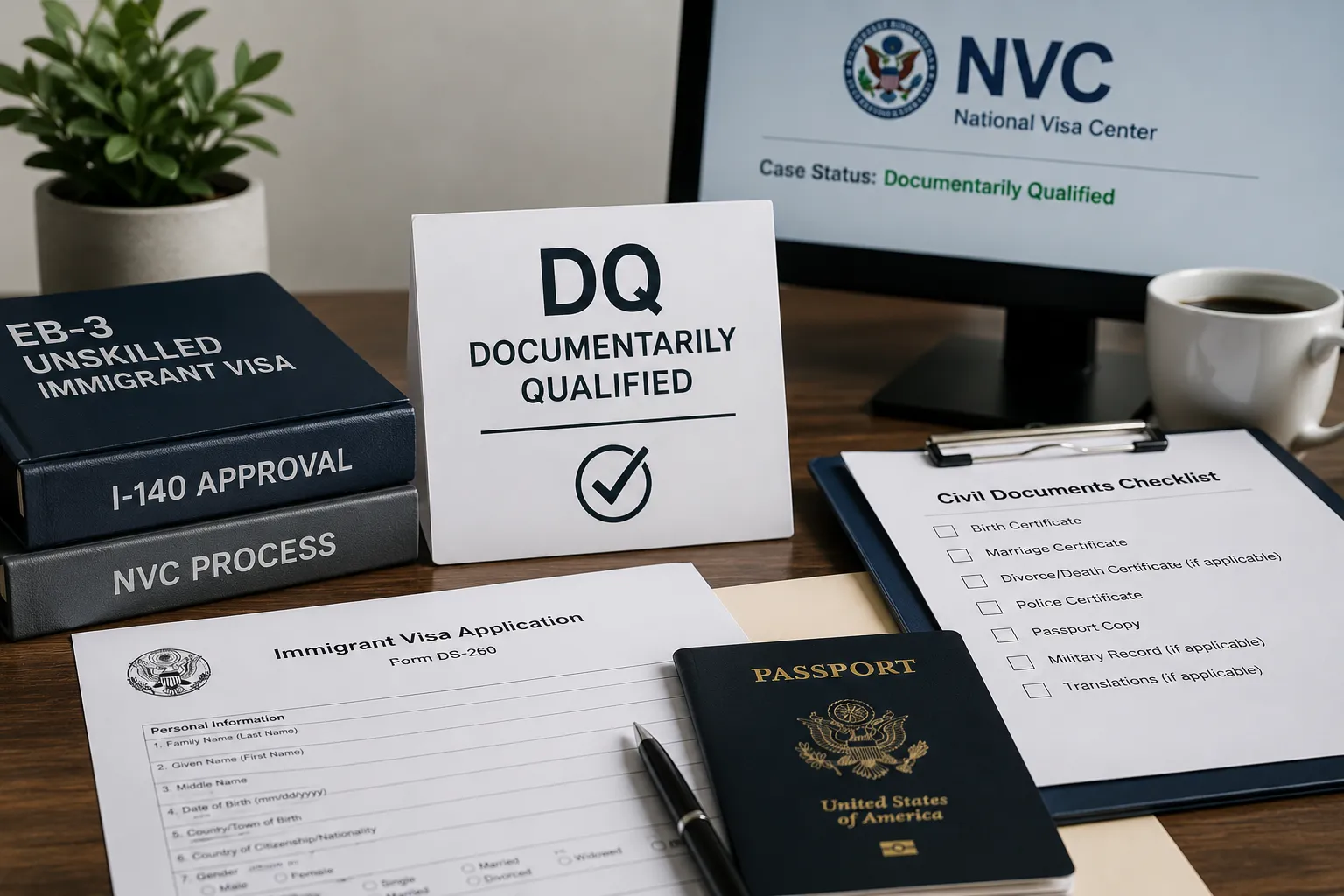
 Why Do So Many People Wait for DQ, and Why Do They Feel
Even More Anxious After Receiving It?
Why Do So Many People Wait for DQ, and Why Do They Feel
Even More Anxious After Receiving It?
When going through the U.S. employment-based immigration process, the atmosphere of the proceedings changes at a certain point. Up until then, the steps are relatively straightforward and visible. You prepare for Labor Certification, file the I-140 petition, and move through the process step by step while waiting for approval.
But at a certain point, a new term appears: DQ (Documentarily Qualified).
And from this point on, many applicants experience similar feelings:
““Is it almost over once I receive a DQ?” “When will my interview
be scheduled?” “Why
has there been no progress for months even though the paperwork is complete?”
What’s interesting is that while DQ is a crucial stage in the entire employment-based immigration process, it is also the most commonly misunderstood stage.
Some people think of DQ as the stage immediately preceding permanent resident approval. Conversely, others understand it simply as the point at which the application has been received.
But in reality, DQ is slightly different from both of those.
DQ is neither permanent resident approval nor simply confirmation of receipt. To be more precise, it is the stage at which the U.S. government officially acknowledges that “this applicant’s immigration visa documents are complete enough to proceed to an interview.”
Once you understand this meaning accurately, it becomes much clearer why the time after DQ feels so long and why interview dates aren’t scheduled right away.
■ WhatIs DQ? The StageWhere the U.S
. Government Acknowledges That “Immigrant Visa Documentation Is Complete”
DQ stands for “Documentarily Qualified,” which literally means “a state in which the applicant meets the eligibility requirements based on the documents submitted.”
In general employment-based immigration (EB-2 and EB-3, including skilled, professional, and unskilled workers), once the I-140 petition is approved, the case is transferred to the National Visa Center (NVC), an agency under the U.S. Department of State.
From this point onward, the applicant proceeds with the actual immigrant visa process through the CEAC system.
During this process, the applicant does more than simply click a “submit” button. They must submit various documents required by the U.S. government.
Typically, this involves completing the DS-260 immigrant visa application form, submitting family relationship documents and birth records, and uploading a criminal history certificate, a copy of their passport, and, if necessary, military service records.
Afterward, an NVC representative reviews the submitted documents one by one.
They conduct a comprehensive review to ensure that no documents are missing, that translations are formatted correctly, and that there are no discrepancies between the application content and the submitted materials.
Once this review is complete and no issues are found, the case status is finally changed to “DQ.”
In other words, it is most accurate to understand that “DQ” is not merely confirmation of receipt, but rather a status in which the U.S. government officially acknowledges that “this case is ready to proceed to the interview stage.”
■ Why IsDQ Important? The MomentYou Become Eligible for an Interview
Many applicants view DQ as just another administrative step. However, it is actually a very important turning point in the entire employment-based immigration process.
This is because you cannot even receive an interview appointment before reaching the DQ stage.
To put it simply, just because you’ve arrived at the airport doesn’t mean you can board the plane right away. You need a boarding pass to actually begin the boarding process.
In the employment-based immigration process, DQ serves a similar role to that boarding pass.
From the U.S. government’s perspective, there is no reason to place a case in the interview queue if the document review has not yet been completed.
Therefore, only after receiving a DQ are you eligible for an interview assignment and can you enter the final stage of the actual green card issuance process.
In this sense, a DQ is not merely a status change but a crucial gateway marking the transition from the preparation phase to the actual visa issuance phase.
■ TheMost Common Misconception People Have About DQ:
Receiving DQ Status Does Not
Mean an Interview Is Immediately Scheduled
The most frequently asked question in the field is, of course, this: “I received DQ
status, so why hasn’t my interview been scheduled yet?”
This question is very natural. This is because most people expect that once the document review is complete, the next step will begin immediately.
However, the actual employment-based immigration system does not operate that simply.
DQ and the interview schedule (P4) are entirely different concepts.
DQ means your application is ready, while an interview appointment is scheduled only when your case reaches the actual visa allocation stage.
In other words, DQ simply means you’re eligible for an interview—it doesn’t mean the interview has been confirmed.
An interview appointment is generally scheduled only after all of the following conditions are met:
- The priority date has been
reached - The Visa Bulletin shows the category is
open - An interview slot at the embassy is
available - The State Department’s monthly visa allocation status
Since both EB-2 and EB-3 employment-based immigration categories are subject to annual visa quotas, it is very common to have to wait for a certain period after receiving a DQ.
Not only for EB-3 unskilled workers but also for EB-2 and EB-3 skilled and professional workers, significant waiting periods may occur after DQ depending on the status of the Visa Bulletin.
■ Why Does Time FeelLike It’s Moving the Slowest After DQ? It’s becausefrom this point on,
the process is driven by the system, not by you
. Interestingly, many applicants say that the period after DQ is the most frustrating part of the entire employment-based immigration process.
The reason is surprisingly simple:
up until that point, there are always tasks for you to complete.
You prepare documents, translate them, submit them, make revisions, and have them accepted. When you take action, you see some results.
However, after DQ, the situation changes completely.
There is almost nothing left for you to do personally. From this point on, you’re in a phase where you wait your turn within the priority date and interview scheduling system.
That’s why it can feel as though the process has come to a standstill.
But in reality, it hasn’t stopped—the way things proceed has simply changed.
You’ve moved from a preparation-focused phase to a queue-based phase.
■ What Should YouPrepare After a DQ? It’s Not a Waiting Period—
It’s a Time
to Prepare for the Interview
Many people think that once they receive a DQ, there’s nothing left to do. However, this is actually the best time to prepare for the interview.
First, it’s a good idea to double-check the expiration date of your passport. It’s also helpful to reconfirm whether you can obtain a replacement criminal background check, as well as review military service-related documents and family relationship documents.
In particular, since consistency between the information you previously submitted and your actual answers is crucial during the U.S. Embassy interview, it’s very important to review the details you entered on Form DS-260.
It’s also a good idea to refresh your understanding of the basic information regarding the company you plan to work for and your job duties.
This is because an employment-based immigration interview is not an English test but rather a fact-verification process.
■ DQ IsNot the End, but a “Ticket to the Final Stage”
In employment-based immigration, DQ is not merely a change in status.
It signifies that, following I-140 approval, you have entered the actual immigrant visa issuance process and is the U.S. government’s official confirmation that you are ready to undergo the interview.
However, it also means that the interview and final review are still pending.
Therefore, the best way to understand DQ is as follows:
DQ does not mean that the path to permanent residency is nearly complete; rather, it means you have entered the final queue to receive permanent residency.
The moment you accurately understand this structure, your vague anxiety will subside, and the entire employment-based immigration process will begin to look much more realistic.