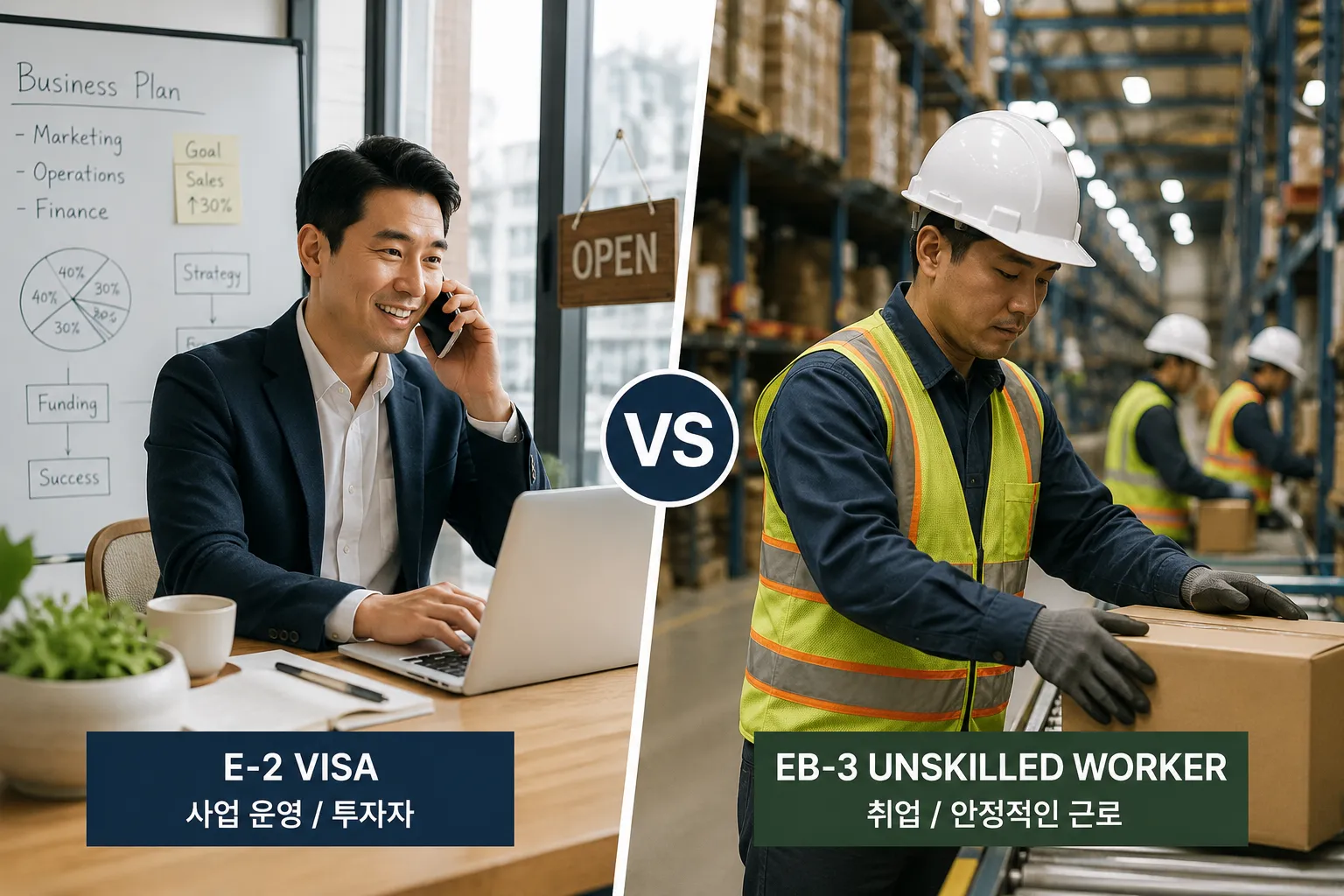
 If your goal is to settle in the United States, which option is more realistic?
When consulting with people considering immigration to the U.S., there’s a question I hear more often than you might expect: “Which is better—the E-2 visa or the EB-3 unskilled worker visa?” Since both programs allow you to live and work in the U.S. and bring your family with you, many people view them as similar options. However, in reality, the objectives and structures of the two programs are completely different, making a simple comparison difficult.
Rather than debating which program is better, it’s more important to first clarify your own goals. The appropriate choice will inevitably differ depending on whether you want to run a business in the U.S. or obtain U.S. permanent residency to settle there long-term.
■ The E-2 Visa Isa Program for Operating a Business in the United States
The first thing to understand when discussing the E-2 visa is that it is not a permanent residency program. While many people view the E-2 as an alternative to U.S. permanent residency, in reality, the E-2 is essentially a nonimmigrant visa intended for business activities within the United States.
The U.S. government does not simply ask E-2 applicants whether they possess the required investment capital. Rather, it places significant emphasis on whether the investment has actually been injected into the business, whether the applicant plans to personally manage the business, and whether the business can make a substantial contribution to the U.S. economy. In other words, the core of the E-2 visa lies not in the investment itself, but in the operation of the business.
Therefore, anyone choosing the E-2 visa must accept the premise that they are not simply residing in the U.S. but intend to operate as an entrepreneur there. Even after establishing a business or acquiring an existing one, they must continue to actively manage the business, and whether the business is being substantively operated remains a critical factor in the review process when applying for future visa extensions.
Ultimately, the E-2 visa can be viewed as a program suitable for those who wish to operate a company in the U.S., hire employees, and grow their business. Conversely, if you have little interest in the business itself and simply want U.S. residency status, this program may prove to be more burdensome than expected.
■ The EB-3 Unskilled Category AimsPrimarily at Obtaining Permanent Residency
In contrast, the EB-3 Unskilled category differs from the outset. While the E-2 is a visa for business purposes, the EB-3 Unskilled is an employment-based immigration program designed to obtain permanent residency.
The EB-3 Unskilled category does not place much emphasis on whether the applicant has business experience or investment capital. The key is whether the applicant can be recognized as a worker needed in the U.S. labor market through sponsorship by a U.S. employer. Therefore, the focus is on work authorization and immigration procedures rather than business plans or proof of investment capital.
Above all, the most significant feature of the EB-3 Unskilled category is that its ultimate goal is permanent residency. Once permanent residency is obtained, there is no obligation to maintain a specific business, nor is it necessary to undergo continuous reviews to renew the visa. Additionally, after a certain period, applicants become eligible to apply for U.S. citizenship.
Consequently, for those who wish to settle in the U.S. long-term or who prioritize their children’s education, retirement planning, or establishing a stable foundation for their family’s life, the EB-3 Unskilled category can be a highly attractive option. Although the processing time may be lengthy, the stability of the residency status ultimately obtained is so significant that it is difficult to compare it to that of the E-2 visa.
■ The biggest difference between the two programs liesnot in residency but in the stability of status
. During consultations, many people tend to view the E-2 and EB-3 Unskilled categories as merely different methods of staying in the U.S. However, in reality, there is a significant difference in the stability of their residency status.
The E-2 visa allows you to stay in the U.S. as long as the business remains operational. While it is possible to reside in the U.S. for an extended period as long as the business is operating successfully, it fundamentally has the limitation of being a non-immigrant status tied to the business. If the business performs worse than expected or ceases operations, this could affect the ability to maintain the visa in the future.
In contrast, individuals who obtain permanent residency through the EB-3 unskilled category retain the right to reside in the United States regardless of the business’s success or failure. Permanent residents are not dependent on a specific business and enjoy a more stable status as members of American society.
This difference becomes increasingly apparent over time. When making long-term plans—such as sending children to college, buying a home, expanding a business, or preparing for retirement—the difference between a visa and permanent residency goes beyond a mere technical distinction; it can be a factor that changes the very course of one’s life.
■ While the E-2 is advantageous in terms of processing time alone
,
the cost structure mustalso be considered
One of the greatest advantages of the E-2 visa is its relatively fast processing speed. In many cases, if business preparations are complete and all necessary documents are in order, it is possible to enter the U.S. within a few months.
In contrast, the overall processing time for the EB-3 unskilled worker visa has become significantly longer due to visa quota backlogs. Therefore, from the perspective of simply wanting to enter the U.S. quickly, the E-2 visa may seem much more attractive.
However, it can be risky to base your decision solely on speed. The E-2 visa requires capital investment to establish or acquire a business, and even after obtaining the visa, you must bear various costs and business risks associated with operating the business. While this varies by industry, it is common for investments ranging from tens of thousands to hundreds of thousands of dollars to be required.
In contrast, the EB-3 unskilled category does not require an investment. While costs associated with the immigration process will still apply, there is no burden of having to operate a business. Therefore, for those lacking business experience or who find it difficult to take on investment risks, the EB-3 unskilled category may actually be a more realistic choice.
■ Who Actually Choosesthe E-2?
Looking at actual consultation cases, people who choose the E-2 generally have business experience or are seeking new business opportunities in the U.S. market.
The E-2 can be an excellent option for those who have already operated a business in Korea or who are strongly committed to actively growing their company in the U.S. In particular, the E-2 visa can offer a significant competitive advantage for those who need to expedite their entry into the U.S. market as much as possible or who plan to expand their existing business into the U.S. However, if running the business is not the primary goal, the requirement to continuously manage the business to maintain the visa can be a burden.
■ Who Actually Choosesthe EB-3 Unskilled Visa?
Conversely, those who choose the EB-3 Unskilled visa often aim to settle in the U.S. itself. Major advantages include the fact that no business experience is required and that applicants do not need to prepare a large investment.
Above all, because there is a clear goal of obtaining permanent residency, this category is suitable for those who prioritize long-term stability, even if the processing time is lengthy. In fact, many applicants choose the EB-3 Unskilled category after considering factors such as their children’s educational environment, their family’s future, and the possibility of obtaining U.S. citizenship.
Recently, there has been a growing trend of people considering the EB-3 unskilled category not merely for the purpose of employment, but as a means to establish a new life in the United States.
■ It’s Not About Which Is Better
,
but Which Isa Better Fit
It is difficult to definitively say whether the E-2 visa or the EB-3 Unskilled category is the better program. This is because the two programs are not in competition with each other; rather, they are designed for people with fundamentally different goals.
If you want to operate a business in the U.S. and expand quickly, the E-2 may be more suitable. On the other hand, if your goal is to obtain U.S. permanent residency and settle down long-term with your family, the EB-3 Unskilled category may be a more realistic choice.
Ultimately, the most important thing is to first ask yourself what you want to do in the United States. Once you have a clear answer to whether you want to run a business or obtain permanent residency and settle down, it will naturally become clear which path—the E-2 or the EB-3 Unskilled category—is more suitable for you.

...
