In-depth analysis from U.S. attorneys and immigration specialists.
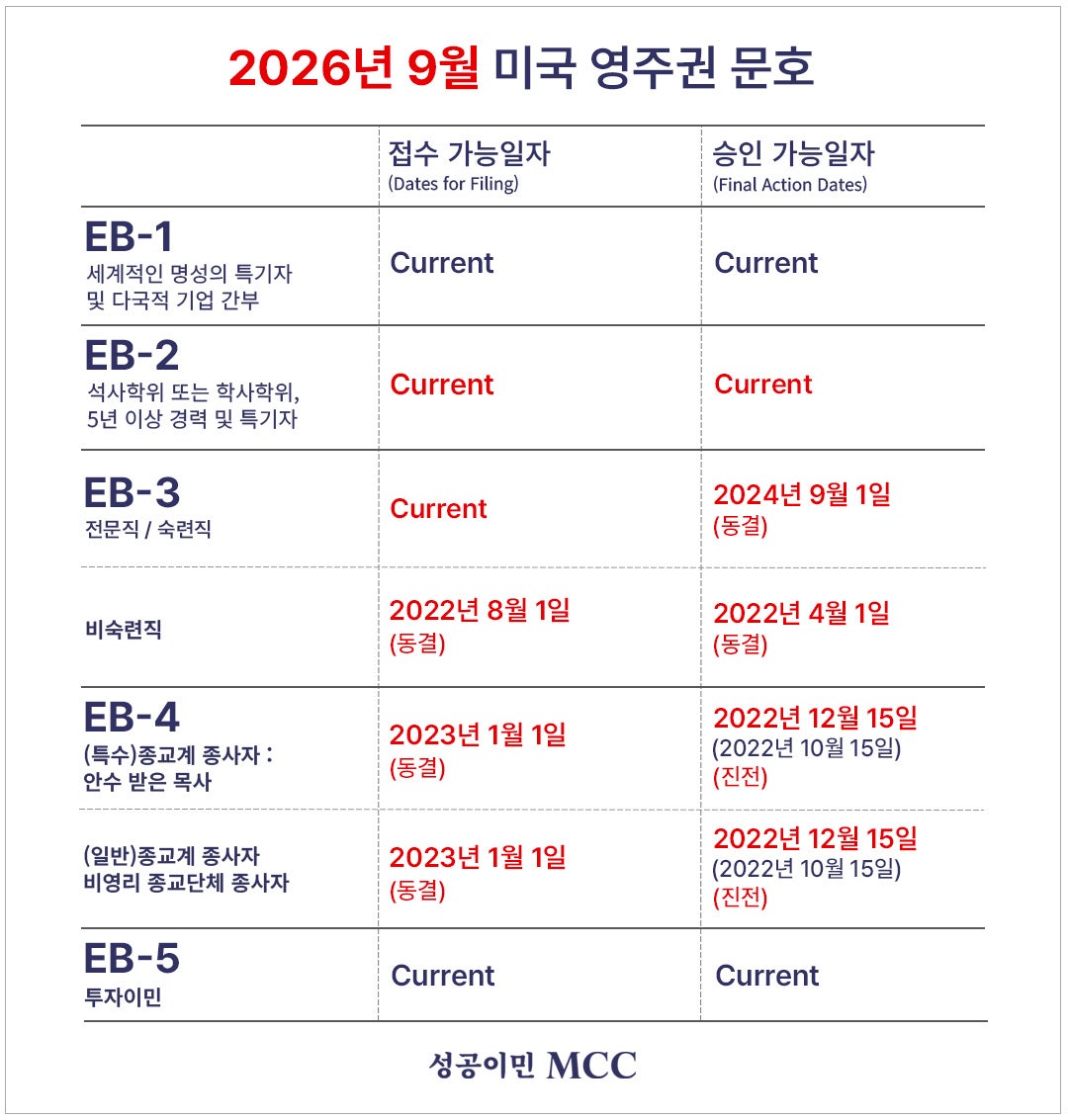
What to Read in the Final Visa Bulletin of Fiscal Year 2026
In the September 2026 Visa Bulletin released by the U.S. Department of State (DOS), the employment-based cutoff dates were, for the most part, held unchanged from the previous month.
Under All Chargeability Areas Except Those Listed, which includes those born in Korea, the Final Action Date for EB-3 professionals and skilled workers stayed frozen at September 1, 2024, and EB-3 Other Workers at April 1, 2022.
EB-2 continues to hold Current status, and the Dates for Filing for EB-3 professionals and skilled workers are also Current. The Dates for Filing for EB-3 Other Workers remained at August 1, 2022.
On the surface, the takeaway from this release is simple.
"The employment-based cutoff dates did not move."
The September Visa Bulletin, however, needs to be read a little differently from other months. The U.S. fiscal year ends on September 30 each year, which makes September the final month for managing the immigrant visa numbers allocated over the course of that year.
Rather than reading this freeze as simple processing stagnation, then, it is worth viewing it as the U.S. government aligning the remaining FY2026 employment-based visa numbers with actual demand.
■ How Have the EB-3 Dates Been Moving Recently?
Looking at the recent flow of the bulletin makes the September freeze somewhat clearer.
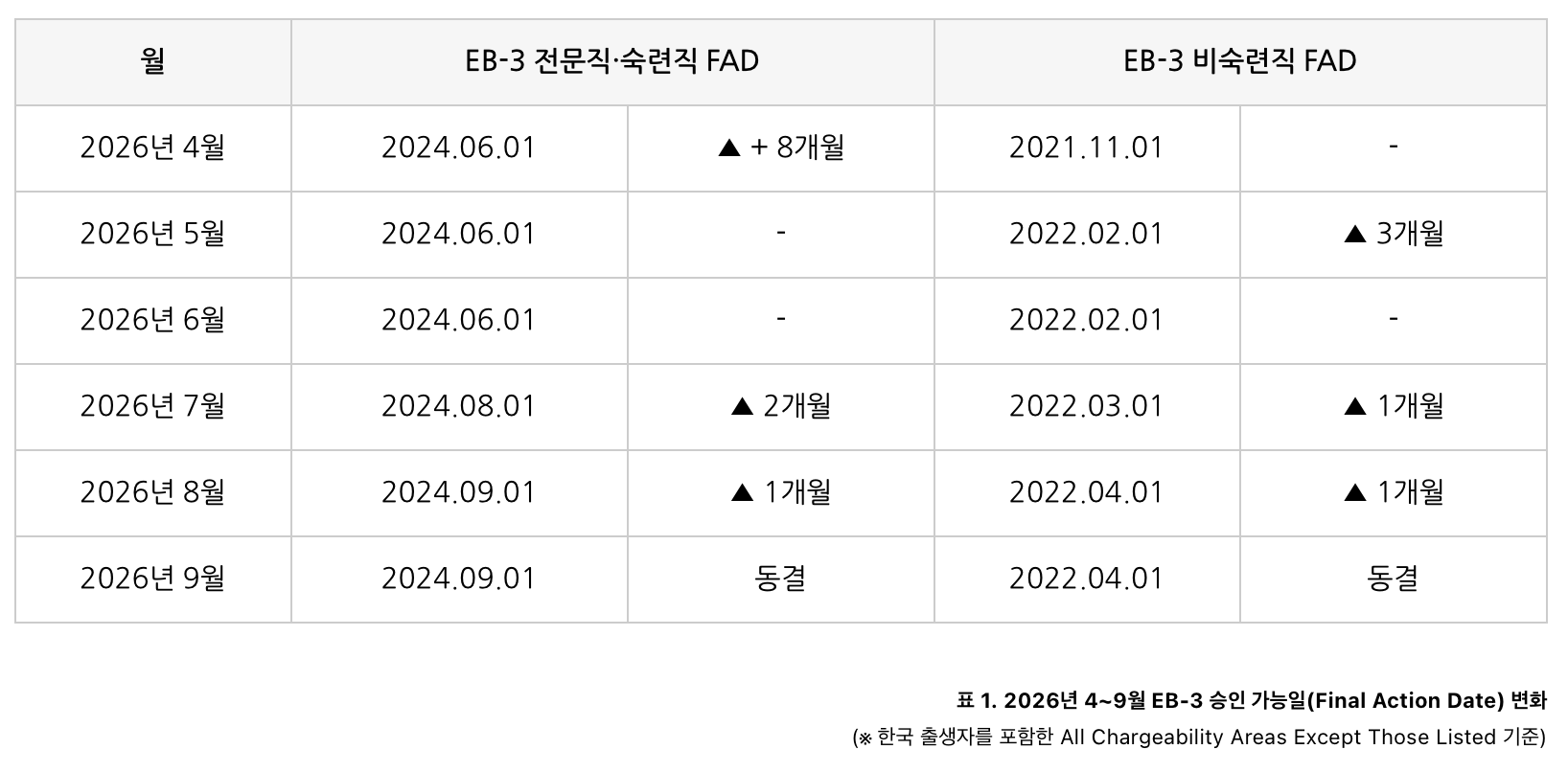
What matters in the table is not September taken in isolation.
EB-3 professionals and skilled workers advanced substantially in April, froze through May and June, moved forward two months in July and one month in August, then froze again in September. Other Workers likewise alternated between advancing and freezing, moving the Final Action Date from 2021 into 2022.
In other words, the recent bulletin has not been continuously blocked. It looks closer to the Department of State progressively widening the approvable range while checking actual visa demand.
■ Why September Is Special — the Visa Bulletin Runs on a "Fiscal Year"
To understand the employment-based cutoff dates, you have to know the U.S. government's fiscal year.
U.S. immigration law does not allow an unlimited number of immigrant visas for employment-based categories. A set number of visa numbers is available each fiscal year, and within that ceiling the Department of State allocates visas across the categories from EB-1 through EB-5.
For FY2026 in particular, the worldwide annual limit for the Employment-Based Preference categories was set at 186,317.
The Department of State does not set the cutoff dates by looking only at the priority dates of filed cases.
It sets each month's cut-off date by weighing together the adjustment of status demand reported by USCIS, immigrant visa demand through U.S. embassies and consulates abroad, visa usage already incurred, and the applicants expected to reach the approval stage going forward.
The way the bulletin is managed early in the fiscal year and late in the fiscal year is therefore bound to differ.
September in particular is the final adjustment window, one in which the visa numbers remaining through September 30 must be used up without exceeding the statutory annual limit.
For that reason, at the end of a fiscal year the Department of State may manage the bulletin more conservatively, freeze or retrogress particular categories, or in some cases switch a category to "Unavailable" altogether.
■ This Time the Department of State Explained the Reason for the Advances Directly
There is one part that deserves particular attention in analyzing the 2026 bulletin.
In the September Visa Bulletin, the Department of State directly explained why it had advanced the dates in several immigrant categories over the past few months.
Immigrant visa issuance for nationals of certain countries declined under the influence of U.S. government measures related to national security and public safety, and as a result, in order to allocate the FY2026 visa numbers to other beneficiaries, the Final Action Dates and Dates for Filing in several categories were advanced over recent months.
This point is quite significant.
It is the Department of State itself showing that advances and freezes are not simply a matter of "did the immigration agency work quickly or slowly."
When visa issuance comes in lower than expected, the dates can be advanced to pull more applicants into the approvable range. Conversely, if more new demand materializes than anticipated, the dates can be halted or adjusted backward again.
In this release the Department of State in fact stated that if additional immigrant visa demand materializes or the relevant administration measures change, retrogression — moving the dates backward — may be necessary in order to keep issuance within the annual limit.
The bulletin, then, is less a simple waiting ticket than a supply-and-demand control mechanism that matches a limited pool of visa numbers to actual filing demand each month.
■ So Is the September Freeze a Bad Sign?
It does not have to be read that way.
The fact that the September EB-3 dates did not advance is certainly disappointing. But it is a stretch to read that immediately as "the backlog has become severe again" or "the dates will not move going forward either."
Looking at the recent flow instead, the Final Action Dates for both professionals and skilled workers and for Other Workers advanced over several months, and those dates were held in September, the final month of the fiscal year.
From the Department of State's standpoint, having already widened the approvable range, it must check actual issuance volume and the remaining numbers before deciding whether to advance further.
The Department of State also states specifically that if the annual limit is reached, it may immediately switch that category to Unavailable and stop allocating visa numbers.
Given this structure, a freeze in the final month of the fiscal year is not necessarily a negative signal; the possibility that it is the result of managing volume so as not to exceed the annual quota deserves equal consideration.
■ Will the Dates Advance Sharply in October?
Once the September bulletin is released, the next question naturally follows.
"A new fiscal year starts in October, so won't the dates open up significantly?"
It is true that once FY2027 begins on October 1, the new fiscal year's employment-based visa numbers become available.
But new visa numbers being allocated and the dates immediately advancing by a wide margin are not the same thing.
Even with a new fiscal year underway, the Department of State has to recalculate the accumulated filing demand, the adjustment of status cases pending at USCIS, immigrant visa demand at overseas consulates, and projected usage in each employment-based category.
Moreover, in this September bulletin the Department of State explicitly mentioned the possibility that the dates could retrogress again if additional demand is confirmed.
In projecting the October bulletin, then, rather than the simple formula "new fiscal year equals a large advance," what matters is checking how many visas are actually allocated for FY2027 and how the accumulated demand takes shape.
■ "Final Action Dates" and "Dates for Filing" Must Also Be Read Separately
Another point worth noting in this September bulletin is the considerable gap between the Final Action Date and the Dates for Filing for EB-3 professionals and skilled workers.
For those born in Korea, the September bulletin reads as follows.
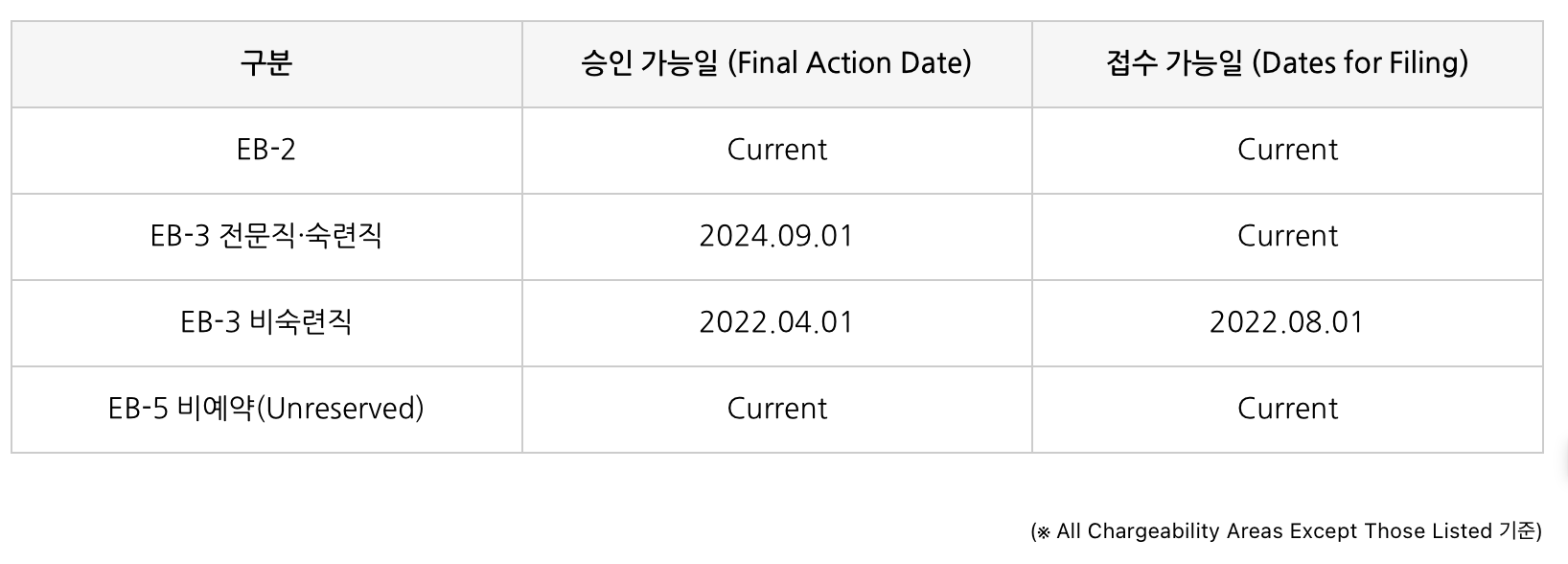
The Final Action Date is the line at which a green card or immigrant visa can actually be finally approved, while the Dates for Filing is a line set earlier so that document submission can proceed ahead of that.
For I-485 filings inside the U.S. in particular, USCIS separately designates each month which chart may be used, so you should not assume that every applicant can immediately file an I-485 simply because the Dates for Filing chart is open in the Visa Bulletin.
Even under the same word "bulletin," the practical meaning changes considerably depending on which chart you are looking at.
■ Our View
The heart of the September 2026 employment-based bulletin lies less in the single word "freeze" than in when and why that freeze occurred.
This month is the final Visa Bulletin of FY2026. The Department of State has entered the point at which it must make a final reconciliation between the employment-based visa numbers allocated for the year and actual usage, and it held the Final Action Dates at September 1, 2024 for professionals and skilled workers and at April 1, 2022 for Other Workers.
More important is the fact that the Department of State directly explained, in this bulletin, both the background to the recent advances and the possibility of future retrogression.
This again demonstrates that the dates in the Visa Bulletin are not simply numbers indicating processing speed, but the product of balancing a legally limited number of visas against actual immigration demand.
What employment-based applicants need, then, is not to overreact to a single month's advance or freeze.
It is important to look at where your own priority date sits, how far the Final Action Date and the Dates for Filing have each come, and how overall demand and visa supply are adjusted as the fiscal year turns over.
The October 2026 Visa Bulletin, released next, carries particular weight as the first bulletin of FY2027.
More important than the September freeze is the level at which the Department of State starts the EB-3 dates once the new fiscal year begins, and the pace at which it adjusts them thereafter in response to actual demand.
Employment-based cutoff dates should be read within the flow of the fiscal year as a whole, rather than judged by a single month's numbers.
U.S. attorneys and immigration specialists review your case in detail and recommend the best path forward.
