In-depth analysis from U.S. attorneys and immigration specialists.
Why Does the U.S. Adjust Its Employment-Based Immigration Quotas "Gradually"?
How the U.S. Department of State Manages Visa Quotas, as Shown in the August 2026 Visa Bulletin
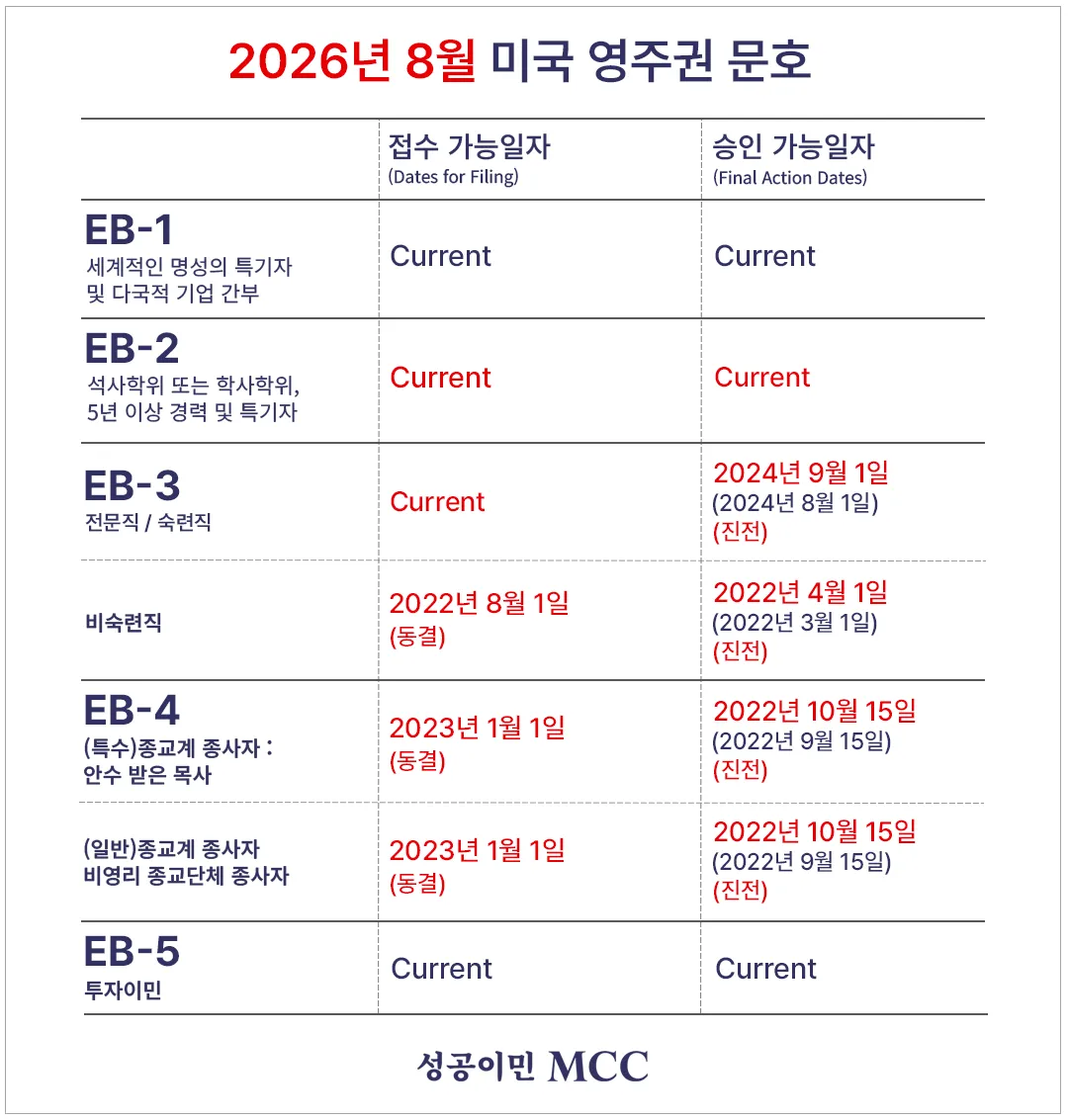
In the August 2026 Visa Bulletin released by the U.S. Department of State (DOS), the Final Action Date for EB-3 employment-based immigration advanced by one month for both professional and skilled workers as well as unskilled workers.
At first glance, the change doesn’t seem significant. As a result, many applicants often react by saying, “It only moved by a month,” or “Hasn’t the quota been blocked again?”
However, in the practice of employment-based immigration, it is not enough to simply look at how many months the dates have advanced. Rather, what is important is why they moved that much and what the U.S. government’s judgment is reflected in those numbers.
This is because the Visa Bulletin is not merely a schedule but a policy document that shows how the U.S. government allocates the limited number of employment-based immigrant visas available each year.
■ What Do Recent Trends in the Visa Bulletin Indicate?
The table below summarizes the changes in the Final Action Date for EB-3 employment-based immigration over the past six months.
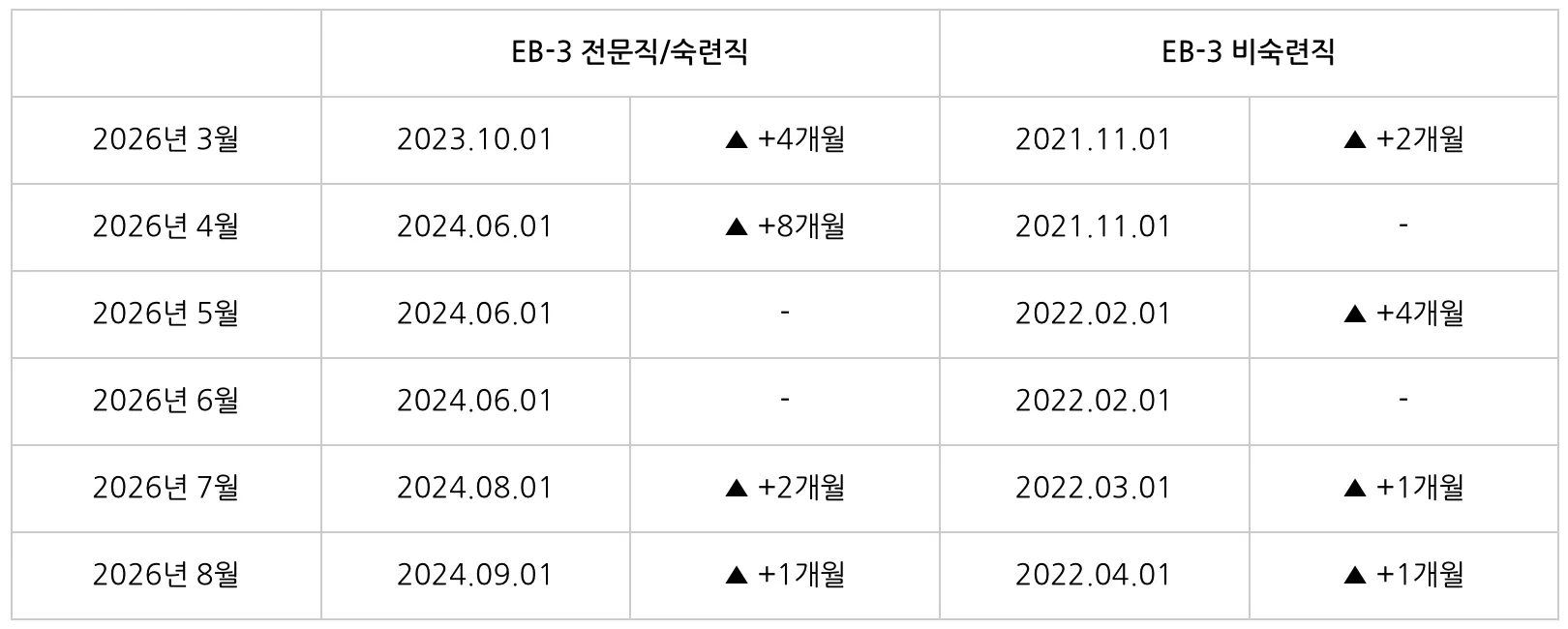
As shown in the table, the priority dates have not advanced significantly each month but have instead alternated between periods of stagnation and slight progress.
This does not simply mean that processing is slowing down. Rather, it can be interpreted as a signal that the U.S. Department of State is managing its annual visa quota while gradually expanding the pool of eligible applicants.
■ The visa bulletin is a system for managing “visa quotas,” not “waiting lists”
Many people view the Visa Bulletin as merely a waiting list where those who apply first receive permanent residency first.
Of course, the priority date is very important. However, what the State Department actually manages is not a simple queue but the annual quota of employment-based immigrant visas established by law.
The number of visas available for employment-based immigration is fixed for each fiscal year. The Department of State adjusts the visa quota by continuously analyzing the number of cases already approved and those likely to be approved in the future.
If the cut-off date advances too quickly, there is a risk that more applicants than expected will become eligible for approval at the same time, exceeding the annual quota. Conversely, if the system is managed too conservatively, the fiscal year may end with unused visas remaining.
Therefore, the Visa Bulletin serves not only as a reference showing applicants’ place in line but also as a management tool for the U.S. government to regulate visa usage.
■ Why was the cutoff date advanced by only one month in August?
August 2026 is approximately two months before the end of the U.S. fiscal year.
This is one of the times when the State Department manages the remaining visa quota most carefully.
If the cut-off date were to be moved forward rapidly at this point and more applicants than expected became eligible for approval, it could lead to a situation where the cut-off date would have to be pushed back (retrogression) or the approval process adjusted later on.
Therefore, gradual adjustments of the visa bulletin by about one month, as seen this time, should be understood not simply as a result of slow processing, but as a policy decision aimed at ensuring the stable management of the annual visa quota.
■ Significant changes in the visa bulletin are not always a good thing
One of the most common questions we hear during consultations is, “Why did the cut-off date move by only one month this month?”
However, in employment-based immigration, a large movement in the visa bulletin is not necessarily a positive sign in and of itself.
In the past, there have been instances where the cut-off date advanced rapidly, only to retreat again after receiving a higher-than-expected volume of applications.
Such sudden fluctuations can reduce predictability for applicants and cause confusion regarding processing timelines.
Conversely, even if the cut-off date advances somewhat slowly, maintaining a stable trend is often more advantageous for planning future schedules and processing timelines.
In other words, what matters is not the speed of progress, but how stably the visa bulletin is being managed.
■ Expert Opinion
The August 2026 Visa Bulletin did not show any significant changes.
However, this month’s bulletin served as a good example of how the U.S. Department of State manages employment-based immigration quotas.
The Visa Bulletin is not merely a table listing dates; it is a policy document that illustrates how the U.S. government manages its annual visa quotas.
Therefore, applicants preparing for employment-based immigration should not only look at how many months the cut-off date has advanced this month but also examine the recent trends in the cut-off date and the policy considerations behind them.
There is a clear difference between reading numbers and reading trends. And the starting point for properly understanding the Visa Bulletin lies precisely in understanding that difference.

U.S. attorneys and immigration specialists review your case in detail and recommend the best path forward.
