In-depth analysis from U.S. attorneys and immigration specialists.
The Real Reason Your Green Card Is Taking So Long
Many people focus only on the visa quota, but in reality, they also need to consider the interview backlog
When I consult with people preparing for U.S. employment-based immigration, there’s one question that comes up almost without fail.
“How far has the visa bulletin progressed?”
“When will my priority date become current?”
“Isn’t the visa bulletin ultimately the reason why the green card process takes so long?”
In fact, many applicants tend to focus solely on the Visa Bulletin when calculating the processing time for employment-based immigration. Most of the information available online also centers on the movements of the Visa Bulletin. As a result, people naturally tend to attribute the delays in the green card process solely to the Visa Bulletin.
Of course, the Visa Bulletin is very important. In particular, for EB-2, EB-3 Skilled Workers, EB-3 Professionals, and EB-3 Unskilled Workers, the Visa Bulletin is one of the key factors determining the overall processing time. However, a recent review of cases undergoing consular processing in Korea reveals that it is becoming increasingly difficult to attribute the entire processing time solely to the Visa Bulletin.
This is because, while many people still focus on the visa bulletin, in reality, another queue is determining when permanent residency is granted. And that queue is the interview at the U.S. Embassy.
■ Employment-based immigration is not a process of waiting in a single line, but rather a process of passing through multiple lines
Many people think of employment-based immigration as a single, long queue. It is not uncommon for people to believe that they simply need to wait for the visa bulletin, and once it opens, they will receive their green card.
However, the actual employment-based immigration system operates in a much more complex manner.
Employment-based immigration involves a sequential process involving multiple agencies: the Department of Labor, U.S. Citizenship and Immigration Services (USCIS), the National Visa Center (NVC), the U.S. Department of State, and the U.S. Embassy. Therefore, applicants must pass through multiple stages in sequence, rather than just one.
At one stage, they wait for the Department of Labor’s review; at another, they wait for USCIS approval; and at yet another, they wait for a visa number to be assigned. Finally, they wait for their turn for the embassy interview.
Ultimately, the total processing time for employment-based immigration is determined not by any single stage, but by the slowest one. In the past, visa availability was often the biggest bottleneck, but recently, interview backlogs have also emerged as a factor that cannot be ignored.
■ Just because the visa category becomes “Current” doesn’t mean you’ll receive your green card immediately
Many people pursuing employment-based immigration view the moment the visa category becomes “Current” as the de facto finish line.
This is an understandable mindset, given that they have spent years waiting for their priority date to become current. However, in the actual consular processing, an interview is not automatically scheduled just because the visa category has become current.
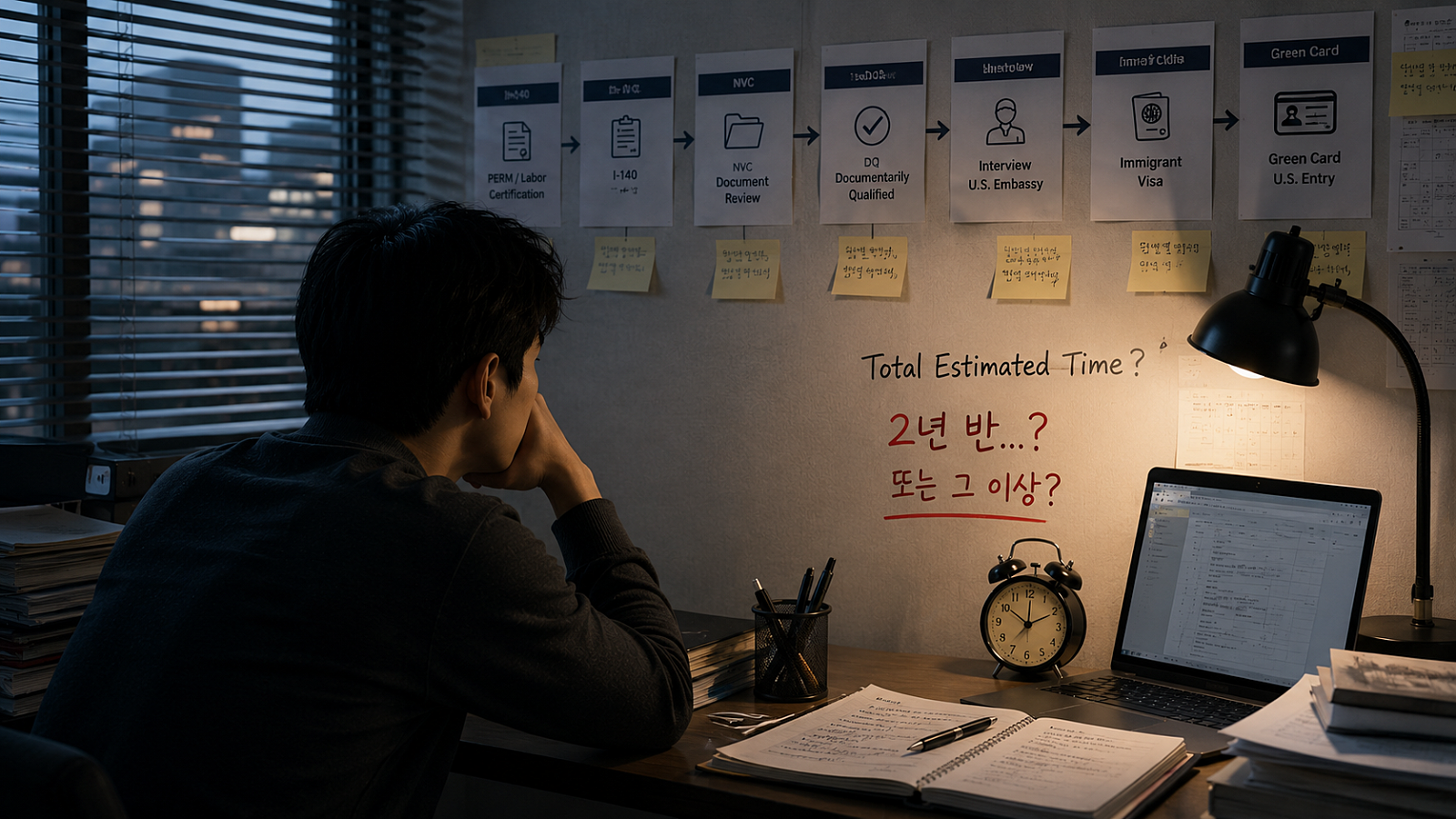
The consular processing for employment-based immigration generally proceeds in the following order: Labor Certification (LC) approval, I-140 approval, NVC filing, DS-260 submission, DQ (Documentarily Qualified), embassy interview, and issuance of an immigrant visa.
The key point here is that there is a stage called DQ between the visa category becoming available and the interview. DQ refers to the status where the NVC has reviewed all of the applicant’s documents and determined that they are ready for an interview.
In other words, even if the visa bulletin has opened, an interview cannot be scheduled if the DQ stage has not been completed. Conversely, even if DQ was completed a long time ago, you will still have to wait if there are not enough slots available for interviews.
Ultimately, the visa quota merely indicates eligibility for an interview; it does not guarantee an interview date.
■ In South Korea, the backlog of interviews has recently become another form of visa quota
Looking at recent cases of employment-based immigration in Korea, an interesting shift is emerging.
In the past, most applicants simply waited for the visa bulletin to become current. However, recently, there has been a growing number of cases where applicants are waiting for an interview even after the visa bulletin has become current.
Simply put, while the number of people eligible for interviews continues to grow, the number of available interview slots remains limited.
From the applicants’ perspective, this can be quite frustrating. After all, the visa category has opened, the NVC review is complete, and they’ve received their DQ notice—yet they haven’t heard anything.
But in reality, a new waiting queue is forming.
While visa availability used to be the biggest bottleneck, interview backlogs have recently become a major factor in determining processing times. In a sense, the interview waiting list is acting as another form of visa availability.
■ Therefore, it is now difficult to estimate processing times based solely on visa availability
One of the most difficult questions I encounter during consultations is:
“If I start now, how many years will it take to get a green card?”
In the past, it was possible to make a rough estimate based solely on the visa bulletin. However, the situation has changed recently.
Not only is it difficult to predict when the visa bulletin will advance, but you also have to consider when an interview appointment will be scheduled after that.
Especially when processing applications through the consulate in Korea, a more realistic estimate requires examining not only the visa bulletin but also the status of the Dereliction of Duty (DQ) review, interview backlogs, and the embassy’s operational conditions.
Therefore, we’ve entered an era where it’s just as important to consider “how quickly interviews are currently being scheduled” as it is to simply ask, “How far has the visa bulletin progressed?”
■ Ultimately, it’s not the visa bulletin that matters, but the entire pipeline
Employment-based immigration is not a sprint.
It is more like a long-term project that begins with the submission of the Labor Certification (LC), followed by I-140 approval, the National Visa Center (NVC) stage, the DQ process, the embassy interview, and finally the issuance of the immigrant visa. Furthermore, the total processing time is determined not by any single stage, but by the slowest stage in the process.
Many people think that the visa bulletin is the be-all and end-all of the green card process, but in reality, there are still several hurdles to overcome even after the visa bulletin is cleared. In particular, we must not overlook the fact that interview backlogs at the Korean consulate have recently become a significant factor in the processing timeline.
Therefore, to accurately understand the permanent residency process, it is necessary to look at the entire process that follows—not just the Visa Bulletin.
One of the most common misconceptions about the permanent residency process is the belief that “once the visa bulletin opens, the process is almost over.” However, in practice, it is not uncommon for the final stage to begin only after the visa bulletin opens.
Ultimately, accurately understanding the permanent residency process means understanding not just a single visa category, but the entire pipeline leading up to the issuance of the permanent residency card. Furthermore, the better one understands this process, the more realistically they can plan and respond, even when unexpected delays occur.
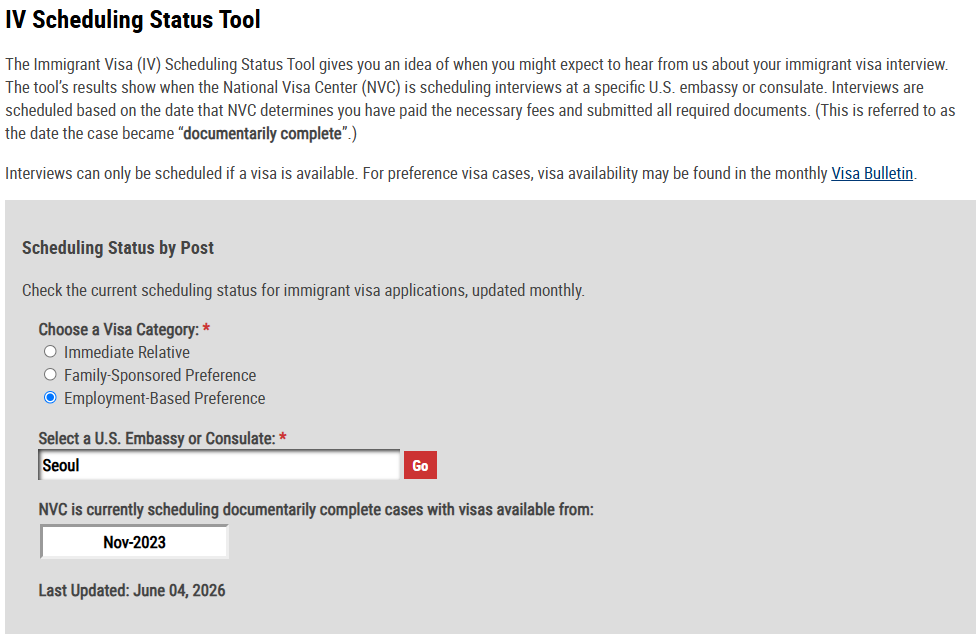
As of June 2026, the U.S. Embassy in Seoul is scheduling employment-based immigration interviews for cases with a Date of Qualification (DQ) of November 2023.

U.S. attorneys and immigration specialists review your case in detail and recommend the best path forward.
