 Why Is the Wait Time for EB-3 Unskilled Always So Long?
In the U.S. employment-based immigration system, EB-3 Unskilled (Other Workers) is always known for its "long wait time." Recently, Korean applicants too have faced an average wait of more than five years, and many applicants ask, "Why does it take so long?"
The answer lies in the annual quota, which sets a fixed number of visas each year. Because EB-3 Unskilled is limited to 10,000 people per year, the waiting line naturally grows longer as the number of applicants increases. So why was this number of 10,000 set, and what does it mean?
■ The Structure of the EB-3 System and the Unskilled Category
EB-3 (Employment-Based Third Preference) is the category corresponding to the third priority among employment-based immigration categories. While EB-1 is for "individuals of extraordinary ability, outstanding professors and researchers, and multinational executives," and EB-2 is for "those with advanced degrees or exceptional professional ability," EB-3 covers a much broader range.
EB-3 is further divided into three subcategories.
- Skilled Workers – occupations requiring at least 2 years of experience or training
- Professionals – occupations requiring at least a bachelor's degree
- Other Workers (Unskilled) – occupations requiring less than 2 years of experience or no special education requirement
Among these, "Other Workers" is what is commonly referred to as EB-3 Unskilled.
■ The Legislative Background of the 10,000-Person Quota
The quota for EB-3 Unskilled is limited to 10,000 people per year, as set forth under the U.S. Immigration and Nationality Act (INA).
The legislature's intent is clear.
- To prevent an excessive influx of foreign labor into the low-wage labor market
- To give priority protection to jobs for U.S. citizens and lawful immigrants
- Yet, at the same time, to allow a certain level of foreign labor into fields that genuinely face labor shortages
In other words, the figure of 10,000 is a compromise number set between "labor market stability" and "the need to supplement the workforce."
■ Just How Small Is the Number 10,000?
Looking at employment-based immigration as a whole, EB-3 is allocated more than about 40,000 visas per year. However, of this, the share that Unskilled can occupy is only 10,000.
Comparing this with other numbers makes the scarcity stand out even more.
- EB-1: more than about 40,000 per year
- EB-2: more than about 40,000 per year
- EB-3 overall: more than about 40,000 (most of which goes to Skilled Workers and Professionals, with Unskilled separately capped at 10,000)
In other words, there are only 10,000 "seats" to be shared among EB-3 Unskilled applicants flooding in from numerous countries around the world.
■ Demand by Country and the Reality for Koreans
EB-3 Unskilled is not limited to any particular country; applicants from around the world compete together.
Countries with especially high numbers of applicants include India, the Philippines, China, and Mexico, and recently the number of EB-3 Unskilled applicants from Korea has also increased sharply.
For example, as labor shortages worsened in the U.S. food processing, logistics, and franchise service industries after the pandemic, a large number of EB-3 sponsoring companies emerged. As a result, in Korea as well, young people, families applying for their children's education, and applicants seeking a career change have flocked to the program, making the wait time even longer.
Therefore, Korean applicants also end up standing in the same "global waiting line," and because of the quota limit, a wait of five years or more becomes unavoidable.
■ Why Does the Wait Time Inevitably Get Longer?
The system for issuing visas is very simple.
- Only 10,000 people are allocated each year
- Priority is given to applicants who filed first
- Remaining applicants are carried over to the following year
In other words, the more applicants there are, the longer the waiting line becomes. In particular, because filing an EB-3 Unskilled case once secures your place in line, the structure favors "whoever gets in line first."
■ Two Meanings of the Quota System
1. The meaning of stability
Having a quota means the program is maintained and does not disappear. Because 10,000 spots are guaranteed to open every year, the sustainability of the program is assured. This gives applicants the certain prospect that "my turn will come eventually."
2. The meaning of scarcity
On the other hand, the small size of this number means the opportunity is scarce. The longer you delay preparing, the longer the waiting line gets, and it could become six or seven years instead of five. In the end, EB-3 Unskilled is a program where "you can only secure your future by filing now."
■ EB-3 Unskilled Compared with Other Programs
- Family-sponsored immigration commonly takes more than 10 years to process. Compared to this, the 5-year wait for EB-3 Unskilled is actually relatively short.
- NIW or EB-1A have demanding requirements and uncertain chances of approval. EB-3 Unskilled has the advantage of a relatively low barrier to entry and higher approval stability.
- Because the E-2 investor visa does not lead directly to a green card, it is ultimately not as stable a path as EB-3 Unskilled.
In other words, EB-3 Unskilled is meaningful as "the one certain green card route open to those who do not meet the requirements for other categories."
■ EB-3 as a Long-Term Strategy
Many people say, "If I have to wait five years, isn't it meaningless?" But what matters is that if you don't file today, you will still be asking the same question five years from now.
EB-3 Unskilled is not a program that grants a green card overnight; it is a program that requires long-term planning.
Therefore, the quota system does not have only drawbacks. Because it is both a limited opportunity and a safeguard that steadily keeps the program running, preparing thoroughly in advance can actually be the wise strategy.
■ 10,000 Is Both a Limit and an Opportunity
The EB-3 Unskilled quota of 10,000 is not just a number. It is the product of a compromise created by U.S. immigration policy in consideration of labor market balance and social acceptability, and for applicants, it is "a limited opportunity given only to those who prepare."
Someone who files today may receive their green card in five years, but someone who files tomorrow may have to wait six years, and someone who files the day after tomorrow, seven years. In the end, EB-3 Unskilled is a program worth the wait, and preparing right now can be said to be the most reasonable strategy.
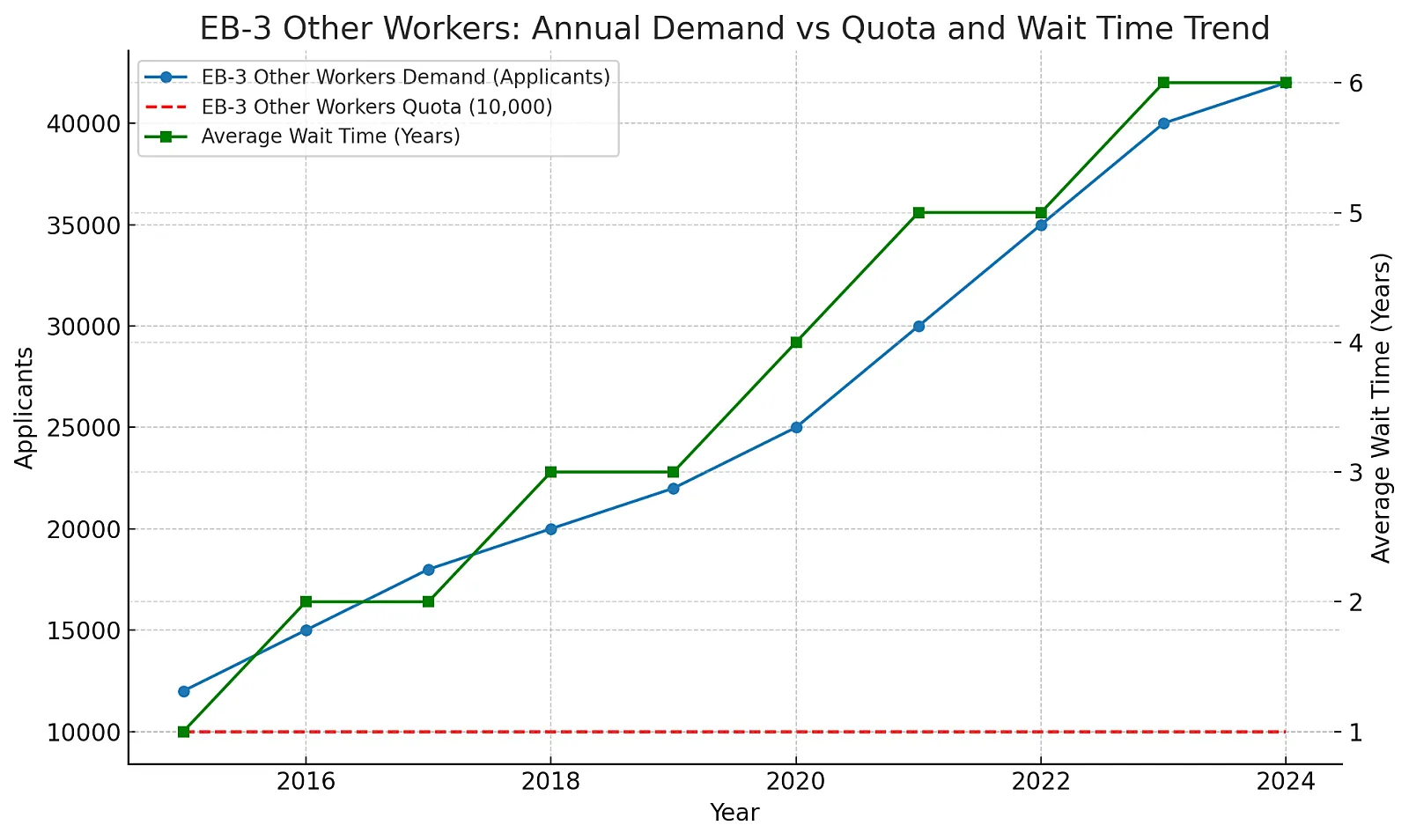
- Blue line: Annual demand (number of applicants) for EB-3 Unskilled (Other Workers)
- Red dotted line: Fixed annual quota of 10,000
- Green line: Average wait time (in years)
* This graph clearly shows the structure in which the wait time grows longer as the number of applicants exceeds the quota.