 There is an important question frequently asked by immigrants preparing to move or who have already arrived in the U.S.
"If I earn income in Korea, do I also have to pay U.S. tax on that income?"
"Do I have to pay tax twice, once in Korea and once in the U.S.?"
This question is very practical and important.
In particular, EB-3 immigrants may continue to have real estate rental income, financial income, or freelance income remaining in Korea for some time even after first arriving in the U.S., so a basic understanding of the tax systems in both Korea and the U.S. and the tax treaty preventing double taxation is necessary.
1. The U.S. Taxes Based on "Worldwide Income"
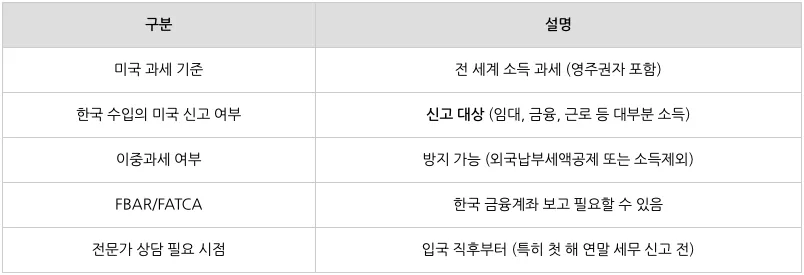
The United States applies the "resident taxation principle" (Taxation of Worldwide Income) not only to citizens but also to permanent residents (green card holders). In other words, if you are a permanent resident living in the U.S., you must report all income earned both inside and outside the U.S. to the Internal Revenue Service (IRS).
Therefore, if you obtain a U.S. green card through EB-3 Unskilled immigration and have income from Korea (such as rental income, dividends, interest, or freelance income), that income must also be included when reporting U.S. taxes.
2. However, the "Tax Treaty" Prevents Double Payment
So does that mean you have to pay tax in both the U.S. and Korea?
Not exactly. Korea and the U.S. are countries that have signed a Double Taxation Avoidance Agreement (DTA).
Under this treaty, methods such as the Foreign Tax Credit or the Foreign Earned Income Exclusion are applied so that you do not pay tax twice on the same income in both countries.
For example:
- If you have already paid tax on that income in Korea, you can avoid double taxation in the U.S. through the Foreign Tax Credit.
- Or, if certain requirements are met, a certain amount can be excluded entirely from U.S. income (this mainly applies to foreign earned income).
This varies depending on the detailed conditions, type of income, and filing method, so you should be sure to get help from a U.S. tax professional (CPA) or an expert well-versed in international tax matters.
3. Even With Income from Korea, Things May Differ If You Are Considered a "Korean Resident"
Meanwhile, if you have not yet entered the U.S., or if your actual period of residence in the U.S. is less than 183 days, you may be classified as a "non-resident alien" under U.S. tax law. In this case, you are only taxed on U.S.-source income, so Korean income may not be subject to reporting.
However, EB-3 Unskilled immigrants become permanent residents immediately upon entering the U.S., and in most cases are classified as a "U.S. tax resident" starting from the year of entry, so it is safer to assume that the obligation to report foreign income does arise.
4. Korean Financial Accounts May Also Be Subject to Reporting (FBAR & FATCA)
In addition, if the total balance of financial accounts in Korea (such as bank deposit or securities accounts) exceeds a certain threshold, a separate financial account reporting obligation (FBAR or FATCA) to the U.S. may arise.
This reporting is for "information reporting" purposes rather than "taxation" itself, but failing to file can result in very large penalties, so caution is needed.
When It Comes to Tax, "Strategy" May Matter More Than "Honesty"
From an immigrant's perspective, taxes can feel like a very complicated and unsettling issue, but the U.S. tax system is structured so that, if you file and manage it properly, legal tax savings are also possible.
What matters most is not missing the filing itself, and whether you are connected with an experienced international tax professional from the outset is key to stable settlement and avoiding legal risk going forward.