■ Same America, Different Paths
One of the systems most frequently compared by those considering entering the U.S. is the EB-3 Unskilled employment-based immigration and the E-2 investor visa. Both systems open a path to legally reside and work in the United States, but they are fundamentally different in legal status, time required, investment requirements, and connection to a green card. Therefore, a strategic choice is needed depending on the applicant's situation and goals.
■ EB-3 Unskilled: A Long-Term Path to a Green Card
■ Same America, Different Paths
One of the systems most frequently compared by those considering entering the U.S. is the EB-3 Unskilled employment-based immigration and the E-2 investor visa. Both systems open a path to legally reside and work in the United States, but they are fundamentally different in legal status, time required, investment requirements, and connection to a green card. Therefore, a strategic choice is needed depending on the applicant's situation and goals.
■ EB-3 Unskilled: A Long-Term Path to a Green Card
EB-3 Unskilled (Other Workers) is a system designed to allow employers to hire foreign nationals for occupations with labor shortages in the U.S. Even without special education or work experience, an applicant can proceed with an immigrant petition (I-140) sponsored by an employer, and approval leads to obtaining a green card.
- Key requirements: employer sponsorship required, low education/experience restrictions
- Quota: limited to 10,000 people per year
- Time required: average of 5 years or more (including waiting)
- Result: Green card → freedom of job choice
In other words, the biggest advantage is that it reliably leads to a green card, even though it takes a long time.
■ E-2 Investor Visa: Rapid Entry into the U.S.
The E-2 visa is issued to nationals of countries that have an investment treaty with the U.S. when they invest a certain amount to establish or acquire a business. Korea is also a treaty country, so applications are possible.
- Key requirements: typically an investment of $200,000 to $300,000, business operation
- Time required: can be issued within a few months
- Residency status: nonimmigrant visa (no automatic connection to a green card)
- Extension possibility: can be extended indefinitely as long as the business is maintained
In other words, it is a system that allows you to quickly start a business in the U.S., but it does not lead to a green card.
■ EB-3 Unskilled vs E-2 Investor Visa: Key Comparison
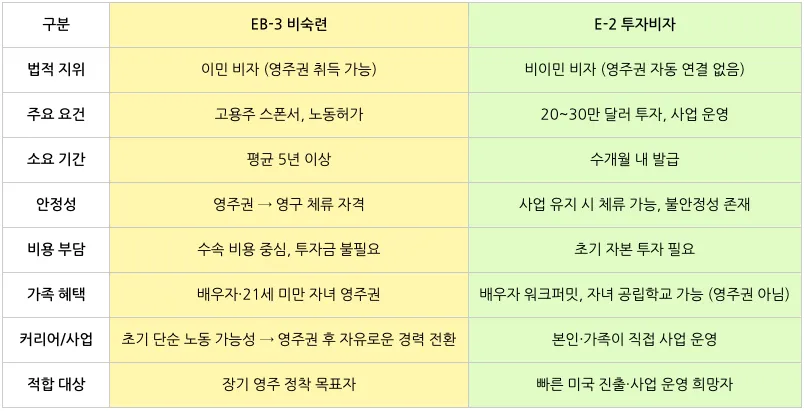 ■ Selection Criteria by Situation
1. If a green card is the final goal → EB-3 Unskilled
The waiting period is long, but it leads directly to a green card. It is suitable for the purpose of children's education and family settlement, and does not require large capital.
2. If rapid entry into the U.S. and business experience are the goal → E-2 Investor Visa
You can obtain residency status quickly and can also operate a business. However, since it does not lead to a green card, you should consider switching strategy afterward to EB-5 investor immigration or EB-1C.
3. Combined strategy: EB-3 and E-2 in parallel
- Enter the U.S. first with E-2 to start business and life
- Simultaneously file EB-3 Unskilled to secure a green card in the long term
This way, you can prepare both your immediate living foundation and your future settlement foundation at the same time. Residency is guaranteed by maintaining the business, and after EB-3 approval, you can convert to a stable green card.
■ Short-Term Speed vs Long-Term Stability, and a Customized Strategy
Both EB-3 Unskilled and the E-2 investor visa have clear advantages and disadvantages.
- E-2's advantages are speed and freedom of business activity, but it has no connection to a green card.
- EB-3 has the burden of a long waiting period, but ultimately provides the stability of securing a green card.
Therefore, the strategy should differ depending on one's financial situation, children's education plans, and long-term settlement intentions.