 In the U.S. employment-based immigration process (including EB-3 Unskilled), an I-140 approval means you have passed an important first gateway. However, there are still many steps to go through before actually obtaining a U.S. immigrant visa. The central procedure in this process is the NVC (National Visa Center) stage. At this stage, the applicant's identity, family relationships, criminal history, and health status are checked, and finally the issuance of the visa is decided through an interview at the U.S. embassy.
This column explains in detail, from an expert's perspective, the concepts and actual procedures of the P3 letter, DQ, and P4 letter, which confuse many applicants.
1. Transfer to the NVC Stage After I-140 Approval
Once the I-140 immigrant petition filed by the employer is approved, the case is transferred to the National Visa Center (NVC). The NVC is an agency under the State Department that manages the data of immigrant visa applicants worldwide and handles all administrative procedures prior to the interview stage.
At this point, the applicant is assigned a case number (e.g., SEO2025XXXXXX), and all subsequent processing is carried out through an online portal called CEAC (Consular Electronic Application Center). The CEAC system manages the entire process, including fee payment, completing the DS-260, and uploading scanned documents.
2. The P3 Letter: The Official Start of the Visa Application
① Meaning of the P3 Letter
The P3 letter (Packet 3 Letter) is an official notice saying "now begin your immigrant visa application." It is sent by the NVC after I-140 approval, and it provides detailed guidance on the first steps the applicant must take.
② Key Contents
- Instructions for completing the DS-260 online immigrant visa application
- Fee payment instructions: immigrant visa application fee (about $345)
- List of Civil Documents to submit
· Birth certificate or family relationship certificate
· Marriage certificate or divorce/death certificate
· Police certificate (a certificate of no criminal record is required even if there is no criminal history)
· Military service record (if applicable)
· Copy of passport (valid for at least 6 months)
- Guidance on accessing the CEAC account and upload instructions
③ Submission Method
In the past, original documents were mailed to the NVC, but currently most countries, including Korea, have switched to the CEAC online upload method. Applicants scan and upload their documents, and bring the originals to the interview.
3. DQ (Documentarily Qualified): Document Review Complete
① Meaning of DQ
Once the applicant submits the DS-260 and uploads all civil documents, an NVC officer reviews them. If all documents are determined to be sufficient, the case is marked as DQ (Documentarily Qualified). This means "documentarily ready, awaiting interview scheduling."
② Importance
- DQ is a required condition to be scheduled for an interview.
- If there are omissions or errors, the NVC will send a Checklist Letter requesting corrections. In this case, the entire schedule may be delayed.
- Therefore, translation notarization, document format, and scan quality must all be carefully prepared.
4. The P4 Letter: Notice Confirming the Interview Schedule
① Meaning of the P4 Letter
The P4 letter (Packet 4 Letter) is the final notice informing the applicant that the interview schedule has been confirmed. It is sent after the P3 and DQ processes are completed and the priority date becomes current.
② Key Contents
- Interview date, time, and location (e.g., the U.S. Embassy in Seoul)
- Guidance on the designated hospital and the immigrant visa medical examination procedure
· A tuberculosis (TB) test is always included
· A visa cannot be issued if active tuberculosis is present
- Documents to bring on the day of the interview
· All original documents
· Passport and photos
· Sealed envelope with medical examination results
- Interview schedule guidance for accompanying family members
③ Procedure
After receiving the P4 letter, the applicant must complete the medical examination and attend the embassy interview on the designated date. If approved at the interview, an immigrant visa is issued in the passport, and after entering the U.S., the applicant receives a Green Card.
5. Summary of the Entire Process
- I-140 approval → NVC case created
- P3 letter received → DS-260 and civil documents submitted
- NVC document review → DQ status granted
- P4 letter received → interview schedule notified
- Medical examination and interview attendance → visa approval → entry into the U.S. and receipt of green card
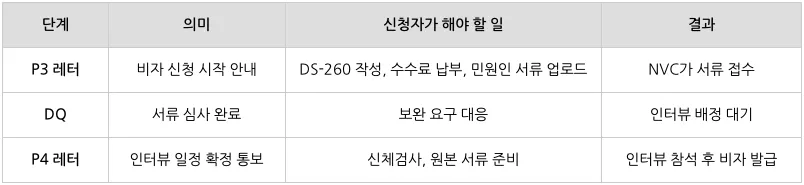
*Differences Between P3, DQ, and P4
 6. Common Problems and Solutions
- Missing documents: The most common cause of delay is a missing birth certificate or police certificate. You must prepare according to the NVC checklist.
- Translation notarization issues: All non-English documents require English translation and notarization. If insufficient, resubmission will be requested.
- Tuberculosis testing: Korean applicants often have a history of tuberculosis, so additional testing may be requested. Preparing past treatment records is advantageous for the review.
- Insufficient interview preparation: If you forget the originals on the day of the interview, issuance will be delayed due to requests for supplementation.
7. Thorough Preparation Is Essential
I-140 approval is only an important beginning of U.S. employment-based immigration, not the end. You can ultimately obtain your immigrant visa only if you accurately understand and thoroughly prepare for the three gateways of P3, DQ, and P4 at the NVC stage.
- P3 is the start of the immigrant visa application
- DQ is the completion of document review
- P4 is the confirmation of the interview
To pass smoothly through this process, it is important to get expert help from the early stages to thoroughly prepare documents, translation, notarization, medical examination, and interview preparation.